
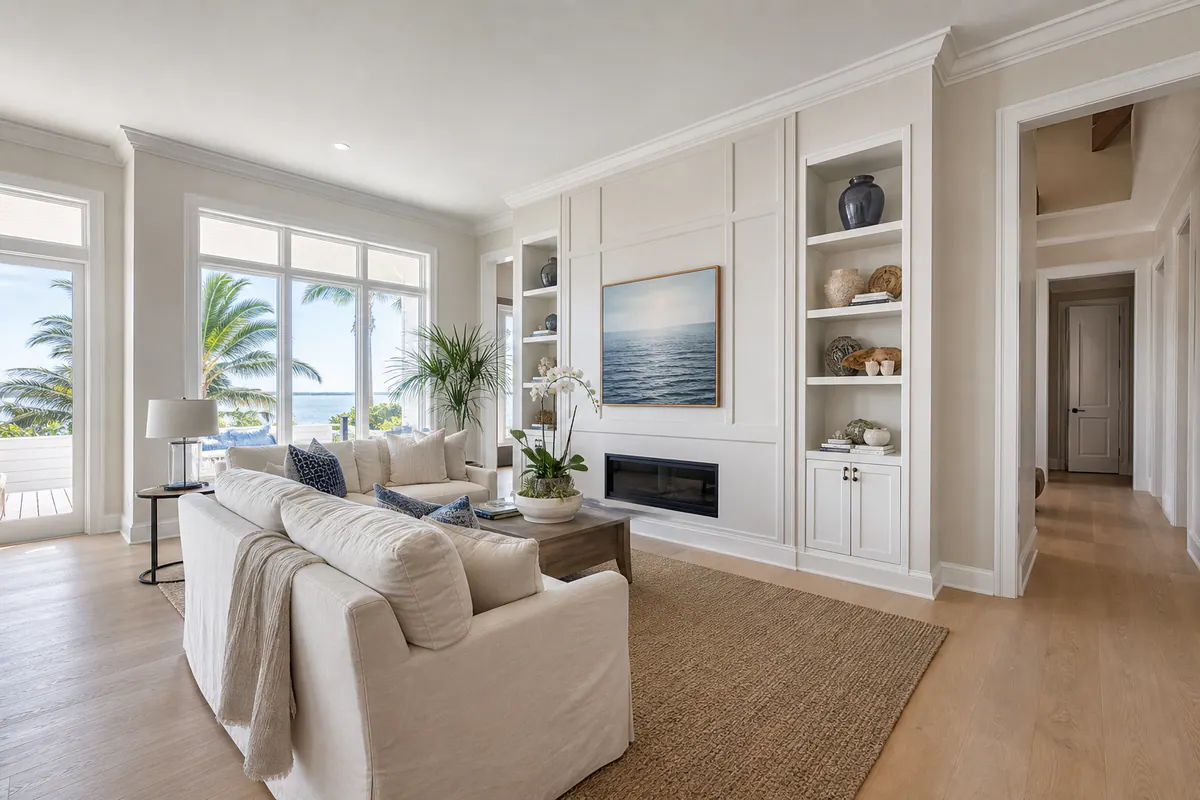
Trim is the finishing layer that makes a room's architecture read clearly rather than feel like a collection of surfaces meeting at random. Thoughtful trim installation in Siesta Key homes creates crisp transitions where floors meet walls, walls meet ceilings, and doors, windows, and built-ins meet surrounding finishes. It can give an updated room the visual weight it was missing, or help original details feel deliberate again.
Interior finish carpentry is primarily about proportion and precision. Baseboards ground the room; casing frames openings; crown molding shapes the ceiling line; and custom paneling or built-in trim can turn a plain wall into an architectural feature. The strongest results show consistent reveals, tight miters, clean scribe work along uneven floors, and profiles that suit the room's ceiling height and overall style, not simply the largest molding available.
Exterior trim serves a different purpose. Around windows, doors, fascia, soffits, and corners, it must finish the home attractively while addressing exposed joints, paint breakdown, and areas where moisture can reach underlying materials. On Siesta Key, the relevant decisions include how exposed a location is, whether the substrate remains sound, how water is directed away from openings, and whether the selected trim material and paint system work together. Loose boards, open caulk joints, soft areas, or repeated peeling call for more than a cosmetic repaint.
Finish carpentry in Siesta Key should therefore balance interior refinement with practical attention to the home's weather-exposed details.
Interior Trim Installation: Profiles, Proportion, and Room-by-Room Detail
A trim package works best when its parts read as one system rather than as individual upgrades. Baseboards establish the lower edge of the room, door and window casings frame openings, and shoe molding is the small flexible-looking strip that covers the gap where flooring meets baseboard. Paneling adds planned texture to a broad wall, while a reveal, a deliberate narrow shadow gap, can create a crisp, modern break between surfaces without a decorative profile.
Scale changes the effect. A narrow, square-edge baseboard with flat casing keeps a compact bedroom or contemporary renovation visually quiet. In a larger room with taller ceilings, a more substantial baseboard and wider casing can prevent the openings from looking undersized. The goal is not to make every profile larger; it is to give the floor line, openings, and ceiling enough visual weight to relate to the room around them.
Simple contemporary packages usually rely on flat stock, square edges, restrained reveals, and consistent widths. They suit clean-lined cabinetry, large-format tile, and minimal wall treatment. Layered traditional profiles build depth with backbands, stepped casing, cap details, or more shaped baseboards. They can complement paneled doors and established architectural details, but ornate built-up trim can feel crowded in a low-ceilinged room or against an otherwise modern renovation.
Painted trim makes profile and shadow lines the main feature; stained wood makes grain, species, and color matching part of the decision. Existing doors, flooring, and cabinetry should guide that choice so a new casing does not look like an unrelated finish. For interior trim installation in Siesta Key, room-by-room continuity often matters more than using identical molding everywhere: a primary living area may carry a fuller profile, while closets, utility spaces, or streamlined bedrooms stay simpler.
At installation, the visible checkpoints are straightforward: casing widths should repeat consistently, reveals around doors and windows should align, miters should meet tightly, baseboards should be scribed to follow an uneven floor, and caulk lines should be clean rather than used to hide gaps. Those details are what make residential trim work feel fitted to the home instead of merely attached to the wall.
Custom Trim and Millwork for a More Intentional Interior
Custom millwork earns its place when it organizes a wall or solves a visual need that plain trim cannot. Wainscoting, a lower-wall treatment divided by rails, panels, or vertical battens, can give a dining room, hall, or entry a grounded edge. Full-height paneling or a feature wall can give a long, uninterrupted living-room wall a focal point. The strongest layouts use panel widths and rail heights that relate to the wall itself, rather than forcing identical boxes into every available inch.

Furniture and openings should set the composition. A low rail can disappear behind a sofa, while one that intentionally meets or clears the furniture line reads more considered. Panels should terminate deliberately at a corner, doorway, or window casing instead of leaving a narrow, accidental-looking strip at the end. Around cased openings, custom transitions may include a continued panel rail, a widened jamb return, or a clean stop that preserves the opening as its own architectural element.
Coffered ceilings use intersecting beams or applied grids to break up a broad ceiling plane; they suit generously scaled rooms where the depth will not crowd the ceiling. Built-ins take a more functional route, combining shelving, cabinets, window seats, or media storage with a tailored surround. A shallow bookcase on a quiet wall can add useful rhythm, while an oversized built-in in a compact room can make the space feel compressed. Custom trim in Siesta Key homes should extend the home's existing language, restrained and linear, softly traditional, or more layered, rather than introduce an unrelated decorative theme.
Paint-grade millwork is selected for a smooth painted finish, so its profile, seams, and shadow lines carry the visual effect. Stain-grade woodwork puts the wood itself on display, making grain direction, color variation, and matching with nearby doors or cabinetry more consequential. Either approach can look refined; mixing them works best when the change is clearly tied to another element, such as wood cabinetry or a ceiling beam.
Well-executed Siesta Key finish trim shows balanced spacing, crisp inside and outside corners, consistent depths, and intentional end points. On built-ins, face frames should align with adjacent paneling or casing, and scribed edges should follow imperfect walls without leaving a caulk-filled gap. Those quiet alignments are what make custom work feel integrated rather than added on.
Crown Molding and Ceiling Details for Straight, Vaulted, or Uneven Spaces
A ceiling line can either complete a room's composition or call attention to every irregularity around its perimeter. Crown molding adds value when it gives a tall or generously scaled room a more finished upper edge and relates naturally to the casing, paneling, or built-ins below. Its visual weight should rise with the room: a narrow, simple profile can suit a standard-height bedroom, while a taller ceiling can carry a deeper, layered profile. In a compact room, overly large crown can make the ceiling feel lower rather than more refined.
For crown molding in Siesta Key homes with clean contemporary architecture, a restrained transition, or even a crisp reveal, may be the better fit than an ornate profile. A soffit, exposed beam, return-air grille, or closely spaced door headers can also make continuous crown feel crowded. Selective use around a formal dining room, primary suite, or coffered ceiling can preserve the detail where it has room to read without forcing it through every space.
Vaulted ceilings require a layout decision before material is cut. Crown can follow the slope with angled transitions, stop and return at a beam or wall change, or give way to a simpler flat trim that handles changing angles more quietly. Uneven drywall and out-of-square corners deserve the same attention: rigid molding should be scribed or the design adjusted, not pulled into place and buried under a wide caulk line.
The profile alone does not determine the result. Inside corners are often coped, one piece is shaped to fit the face of the other, so minor movement or imperfect corners are less conspicuous. Outside corners rely on accurate miters, while small surface imperfections need appropriate filler, sanding, primer, and a smooth paint finish. A strong installation has a deliberate starting layout, tight joints, even contact at the ceiling, and paint-ready seams that do not announce themselves from across the room.
Exterior Trim Repair for Coastal Exposure: Repair, Replacement, and Material Choices
Outside, a hairline paint crack can be a finish issue, or the first visible clue that water is reaching the trim assembly. Around windows and doors, along fascia and soffits, at corner boards, and beneath roof edges, peeling paint deserves a closer look when it accompanies soft wood, open seams, loose boards, dark recurring stains, swollen edges, or caulk that has separated from both surfaces. These conditions matter because a new coat of paint can improve appearance without addressing the joint, drainage path, or damp material beneath it.
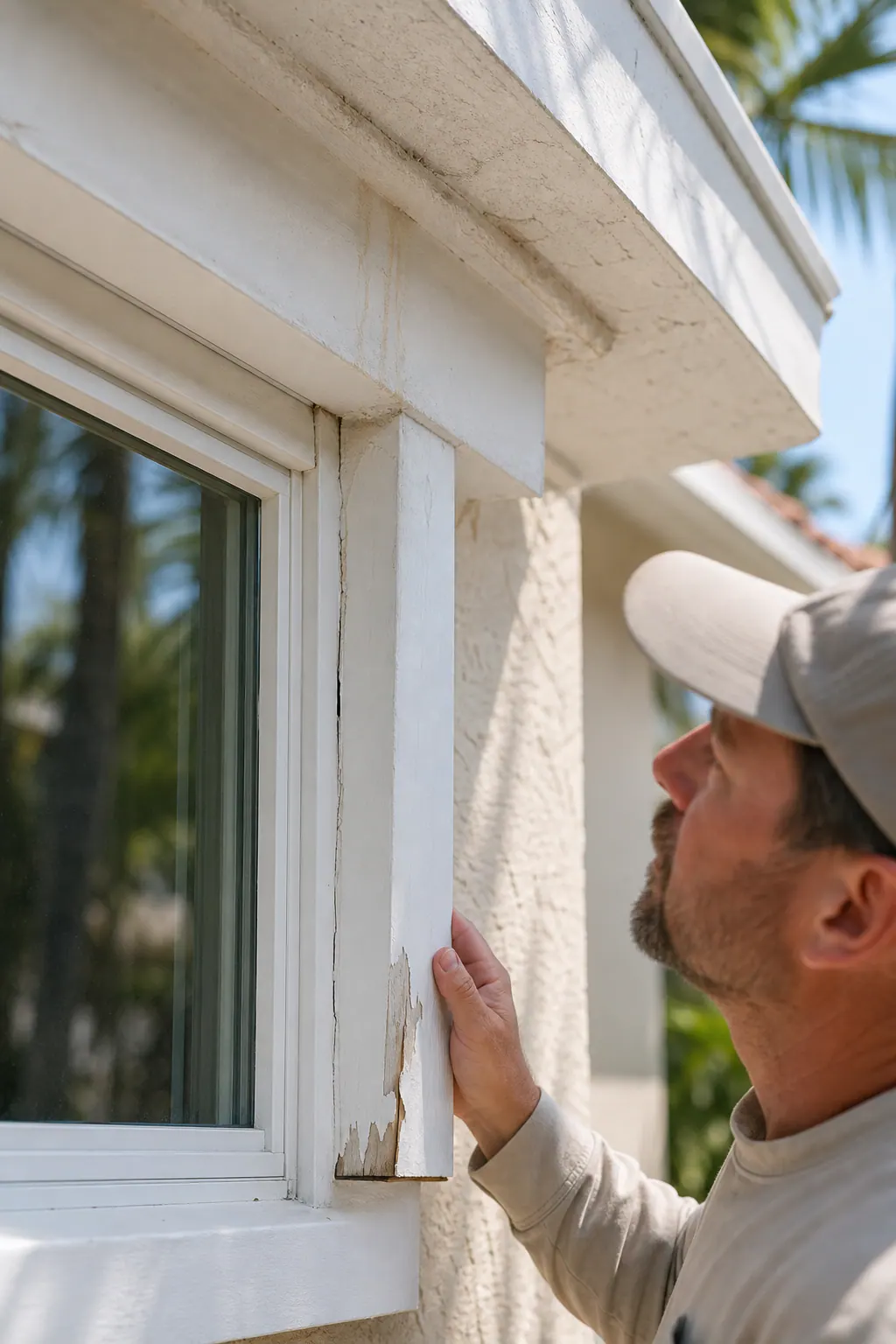
For exterior trim repair in Siesta Key, a localized repair can make sense when the board remains firm, damage is confined to a small area, adjacent substrate is sound, and the water source has been corrected. Replacement is the more durable conversation when decay extends along the board, fasteners no longer hold securely, joints repeatedly open, or deterioration appears around an opening where flashing and surrounding wall conditions may also need attention. A sound repair leaves stable backing, tight joints, intact caulk transitions where appropriate, and a clear path for water to shed rather than collect.
- Paintable wood trim can be a strong visual match for traditional profiles, custom shapes, and homes where a crisp routed edge is important. Its tradeoff is upkeep: exposed end cuts, joints, and paint film need careful preparation and ongoing attention, especially where sun, humidity, salt air, and wind-driven rain reach the elevation.
- PVC trim is a paintable cellular material often chosen for highly exposed boards, such as fascia, rake trim, or casing near weather-facing openings. It does not absorb water like wood, but it moves differently with temperature changes. Allowing for that movement, using suitable fastening and joint details, and selecting a compatible coating system are part of a clean result.
- Other exterior-rated paintable trim products may suit broad boards or specific façade details, but their usefulness depends on the profile required, attachment method, cut-edge treatment, and how the piece meets siding, roofing, or masonry. The material should support the detail, not force a compromise in drainage or appearance.
Material selection should follow exposure rather than a one-material-for-everything rule. A protected porch casing has different demands than a sun-baked fascia board or a corner repeatedly hit by driven rain. Before trim installation in Siesta Key, evaluate where water leaves the roof or wall, whether flashing directs it outward, how joints terminate, and whether the chosen primer, caulk, and finish coat work together. The visible standard is simple: straight, secure boards; closed, purposeful joints; sealed vulnerable cuts where the system calls for it; and no fresh paint concealing an unresolved moisture pattern.
What a Thoughtful Finish Carpentry Scope Should Include
A clear scope begins before the first board is ordered. A trim contractor in Siesta Key should walk the rooms or exterior elevations, note uneven walls and floors, inspect nearby drywall or moisture damage, and identify what must be repaired before finish work can conceal it. The early decisions are visual as well as practical: profile family, painted or stained appearance, material, and where each detail starts and stops.
- Coordinate adjoining finishes. Baseboard height should account for the finished flooring thickness and any shoe molding; casing should meet cabinets, backsplashes, and window returns without creating a narrow, improvised strip. Decide whether flooring, cabinetry, drywall repair, or window work happens first so the trim can be fitted to completed surfaces.
- Measure and plan the package. Confirm repeated casing widths, crown transitions, panel spacing, board lengths, and material quantities before cutting. Older homes may need scribed baseboards or adjusted layouts to follow floors and walls that are not perfectly straight.
- Install, then review in strong light. The punch list should look for consistent reveals, secure fastening, tight miters and coped joints, clean outside corners, and repairs sanded flush. Paint-ready work has purposeful caulk lines and filled fastener holes, not wide gaps relying on caulk to create the finish.
For exterior items, the scope should separate trim replacement from the wall, flashing, drainage, or substrate repair that may need to occur first. That sequence keeps finish carpentry Siesta Key projects from treating a visible board as an isolated problem when the surrounding assembly needs attention.
Plan Trim Upgrades or Exterior Repairs Around Your Home’s Needs
Bring a few decisions to the first conversation: photos of each room or damaged exterior area, approximate dimensions, inspiration images, the finish you want, and a note of what is staying or changing nearby. A painted, streamlined casing package calls for different profile choices than stained wood details or a paneled feature wall; a shaded porch opening has different material demands than fascia exposed to sun and wind.
- Identify the rooms or elevations to be included and the details that should visually connect them, such as baseboards, casings, crown, paneling, or built-ins.
- Point out soft areas, separated caulk, recurring stains, open joints, and peeling finish so exterior trim repair can address the full condition rather than just its visible surface.
- Decide where a consistent whole-home package matters most and where a focused custom detail will have the greatest effect.
Whether the priority is custom trim in Siesta Key, a ceiling detail, or exterior repairs, a project discussion can turn those observations into a cohesive scope based on your home's architecture, existing conditions, exposed locations, and intended finish. Reach out to discuss trim installation in Siesta Key and define the work before selections and cuts are made.
Plan the next step
Review the Siesta Key, FL service area for local planning context.
When you are ready, request a free estimate with the rooms, trim goals, city, and available photos.
FAQs
What is included in finish carpentry for a home renovation?
Finish carpentry includes baseboards, door and window casing, crown molding, shoe molding, paneling, built-ins, and other trim details. Quality work features consistent reveals, tight miters, scribed baseboards along uneven floors, clean caulk lines, and profiles scaled to the room.
Can crown molding be installed in homes with vaulted or uneven ceilings?
Yes. On vaulted ceilings, crown can follow the slope with angled transitions, stop and return at a beam or wall change, or be replaced with simpler flat trim. Uneven drywall and out-of-square corners should be scribed or accommodated in the layout instead of being concealed with wide caulk lines.
What are signs that exterior window trim has hidden water damage?
Warning signs include soft wood, loose boards, open or separated caulk joints, dark recurring stains, swollen edges, peeling paint, and fasteners that no longer hold securely. These conditions can indicate water is reaching the trim assembly, flashing, wall substrate, or joints around the opening.
When should damaged exterior trim be repaired instead of replaced?
Repair is appropriate when damage is limited to a small area, the board remains firm, adjacent substrate is sound, and the water source has been corrected. Replacement is needed when decay extends along the board, joints repeatedly open, fasteners fail, or deterioration affects trim around an opening.
Is PVC trim better than wood for exterior trim near the Siesta Key coast?
PVC trim is often the better choice for highly exposed fascia, rake trim, and window or door casing because it does not absorb water like wood. Wood remains useful for traditional profiles and custom routed details, but it requires careful treatment of end cuts, joints, primer, and paint in sun, humidity, salt air, and wind-driven rain.
Priority services
Services in Siesta Key
Local trim pages for Siesta Key, FL
Explore focused planning pages for every residential trim and finish-carpentry service available in Siesta Key.
Baseboard Installation in Siesta Key
Baseboards do more than frame a room. They cover the wall-to-floor gap, take the scuffs and bumps that might otherwise mark the lower wall, and give tile, wood, vinyl, or carpet a deliberate stopping point. A well-proportioned run of trim also makes a flooring update look complete rather than pieced together.
View serviceBoard and Batten Walls in Siesta Key
Start with the wall's proportions: vertical battens paired with horizontal rails create a structured grid whose lines can make a room feel taller, wider, or more deliberately framed. This decorative molding is distinct from exterior board-and-batten siding; it is a paint-ready wall treatment designed to add shadow lines, depth, and architectural rhythm indoors.
View serviceCabinet and Built-In Trim in Siesta Key
Cabinet trim Siesta Key homeowners choose can make standard cabinetry feel deliberately designed for the room. This finish-carpentry layer adds the clean transitions that separate a basic installation from a tailored one: a crown detail can visually close the space above upper cabinets, a finished panel can give an exposed cabinet end a furniture-like appearance, and a trimmed shelf edge can make open storage look intentional rather than incomplete.
View serviceCoffered Ceilings in Siesta Key
Coffered ceilings in Siesta Key homes can give an open room a stronger sense of order without making it feel enclosed. A coffered ceiling uses a grid of recessed panels framed by trim or beams; the pattern draws the eye upward, gives a broad ceiling more definition, and can echo the room's architecture rather than competing with it.
View serviceCrown Molding Installation in Siesta Key
A crown profile earns its place when its scale suits the ceiling and its edges read as one continuous line around the room. In Siesta Key interiors, that ceiling-to-wall transition can frame airy spaces, carry the eye through an open plan, and connect painted walls, cabinetry, and existing trim with a more composed coastal finish. The goal is not ornament for its own sake, but a profile that feels native to the home.
View serviceCustom Feature Walls in Siesta Key
Custom feature walls in Siesta Key give a room a sense of structure without requiring a full renovation. A thoughtfully treated bed wall can ground the furniture; a dining-wall detail can give an open plan a clearer destination; and a fireplace wall can become a composed focal point rather than a blank backdrop. The best results feel integrated with the home's architecture, not added as temporary décor.
View serviceCustom Finish Carpentry in Siesta Key
Look closely at a door opening: the casing should hold an even reveal, meet the baseboard cleanly, and align with nearby openings. That level of resolution is what separates custom finish carpentry in Siesta Key from simply attaching decorative molding after construction. It addresses wall-to-floor and wall-to-ceiling edges, window and door framing, cabinetry transitions, and details sized to belong in the room.
View serviceDoor and Window Trim in Siesta Key
A consistent reveal, the narrow, even line between jamb and casing, is one of the first details that makes an opening look intentional. Casing bridges the seam where the wall surface meets the door jamb or window frame, while the unit itself handles the opening, closing, or glazing. In a dated condo, that border can hide a ragged drywall cut or exposed gap; in a renovation, it can help a replacement window belong with the rest of the room.
View serviceExterior Trim Repair and Replacement in Siesta Key
For Siesta Key exterior trim repair, the goal is more than making peeling, cracked, or weathered edges look fresh again. Salt-laden air, persistent humidity, intense Florida sun, UV exposure, and wind-driven rain can wear down the paint, caulk, and joints that help keep exterior transitions closed. When those details fail, water can work behind the visible trim instead of simply staining its surface.
View serviceFireplace Mantels and Surrounds in Siesta Key
A fireplace mantel in Siesta Key can do more than frame an appliance: it can give the whole living space a deliberate center. A crisp painted shelf can add a light horizontal line above a firebox, while a tailored surround or new facing can turn a dated opening into a balanced architectural composition.
View serviceNew Construction Trim Packages in Siesta Key
For a new home, trim works best as one finish-carpentry system, not as baseboards, casing, and crown chosen separately at the end. A coordinated new construction trim Siesta Key package brings those pieces together with interior-door details, window returns, floor transitions, material choices, installation order, and a paint plan.
View serviceRemodel Trim Packages in Siesta Key
A remodel trim package treats the details that frame a room as one finish-carpentry plan, not a collection of last-minute add-ons. For remodel trim Siesta Key projects, that plan can coordinate 5- to 7-inch baseboards, door and window casings, crown molding, flooring transitions, and optional wall treatments such as panel molding or wainscot.
View serviceShiplap Installation in Siesta Key
Shiplap can bring structure and softness to a beach-home interior without pushing the room toward a farmhouse look. For shiplap installation in Siesta Key, the refined version is usually defined by an intentional board layout, slim and even reveals, crisp paint, and transitions that relate cleanly to the home's existing baseboards, casing, and crown.
View serviceStair Trim and Wainscoting in Siesta Key
Stair trim gives the route between floors a finished edge instead of leaving it as a blank stretch of drywall. A wall-side skirt board follows the stair run; staircase wainscoting adds protective, paint-grade detail below a planned line; and coordinated baseboards and landing transitions carry the look into adjoining rooms. Together, these elements help handle the everyday marks that collect around hand contact, furniture moves, and busy landing corners.
View serviceTrim Installation in Siesta Key, FL
For homeowners, condo owners, vacation rental managers, and remodelers, trim installation in Siesta Key is the finish work that turns a room from "almost done" into intentionally finished. This service covers professional finish carpentry for coastal properties, condos, rentals, and remodeled interiors where the final lines need to look clean, consistent, and suited to the space.
View serviceTrim Repair and Replacement in Siesta Key
A blistered finish, dark stain, widening joint, or loose piece of casing is a useful checkpoint: it may be a surface flaw, or it may show that water has reached the trim or the surface behind it. In Siesta Key homes, trim at window and door openings, roof-edge boards, baseboards, and decorative molding helps finish transitions while covering vulnerable edges exposed to rain, humidity, salt air, aging paint, and failed caulk.
View serviceWainscoting and Wall Paneling in Siesta Key
Wainscoting in Siesta Key homes can give a room a more finished rhythm: a defined lower wall, a clean trim line, and coastal character that feels tailored rather than themed. In an entry, hallway, or powder room, paneling also gives frequently touched lower walls a more intentional surface; in a dining room or bedroom, it can frame furnishings and make plain drywall feel considered.
View serviceWhole-Home Trim Packages in Siesta Key
Start at the doorway: when a hall opening has a thin, squared casing but the adjoining living area uses a wider, decorative profile, the rooms can read as separate projects. Carrying related baseboard, door and window casing, and, where ceiling height suits it, crown molding through the home creates a clearer visual rhythm from the entry to bedrooms and shared spaces.
View service