
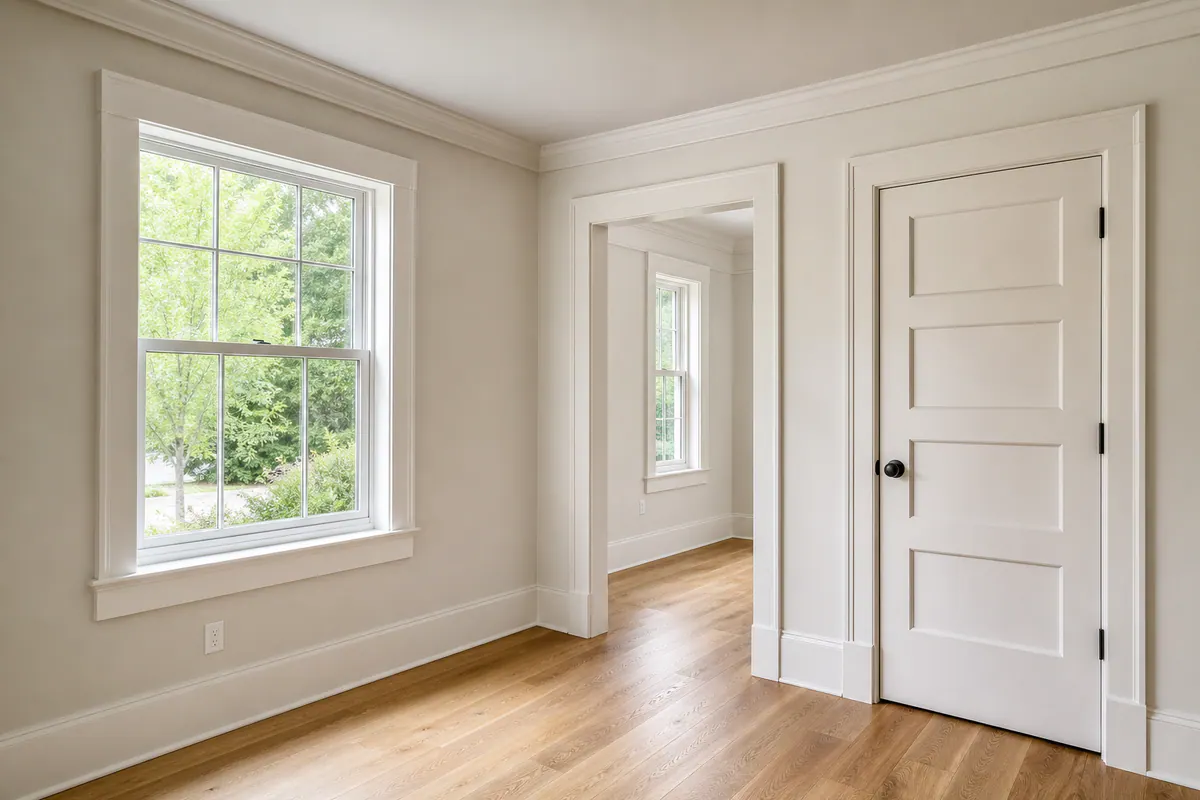
Trim Materials and Profiles: Two Decisions That Shape the Finished Room
Every finished trim package comes down to two connected choices: what the trim is made from and what shape it takes.
Material governs practical behavior. MDF, solid wood, finger-jointed pine, poplar, PVC, and composite trim differ in the finishes they accept, how they handle humidity, how much they can move, and where they make sense to install. Paint-grade and stain-grade are finish-driven categories rather than materials themselves: paint-grade prioritizes a smooth, concealable surface, while stain-grade keeps the wood grain visible as part of the look.
Profile is the trim’s visible cross-section, the flat face, eased edge, bead, groove, step, or curve that creates its shadow lines. A simple square-edged baseboard can be made from MDF, pine, poplar, or PVC; likewise, one material can be milled into clean modern flat stock or a more traditional, layered molding. The material changes the performance and finishing path. The profile changes the room’s character.
Scale and repetition make profiles feel intentional. Baseboard, door and window casing, and crown do not need to match exactly, but related edge details and appropriate projection help them read as one system. The sections ahead compare trim materials and trim profiles as situational choices, not a single ranking, so you can pair the room’s conditions, desired finish, and architectural style with a combination that fits.
How to Compare Trim Materials Before Choosing
Start with the room, not a favorite species. A dry, low-contact living-room casing asks for a different balance than a mudroom baseboard that will meet shoes, vacuums, humidity, and frequent cleaning.
- Finish and grain: Choose stain-grade when visible grain, color variation, and natural character are part of the design. Choose paint-grade trim when the goal is an opaque, uniform painted surface; it may be solid wood, finger-jointed wood, MDF, or another product with a finish-ready face. “Grade” describes the intended visual result, not one species.
- Moisture exposure: Separate ordinary indoor humidity from direct water. A material that works well in a dry bedroom may be a weak fit beside a shower, exterior opening, or other location that can stay wet. PVC and some composite products are typically considered for those more exposed conditions, while many wood-based choices belong in protected interior locations.
- Movement and wear: Wood can expand, contract, and show seasonal movement; MDF is valued for a consistently smooth painted face but is vulnerable where water can reach it. Consider dents and impacts for baseboards, stair trim, and door casings, rather than judging every piece by the needs of low-contact crown molding.
- Machining and upkeep: A built-up detail or custom edge may favor materials that cut and shape cleanly. Exterior-adjacent and frequently cleaned trim also deserves a finish and material combination you are prepared to maintain.
As you compare trim material options, use a simple checkpoint: what should the surface look like, what will touch it, and what conditions will surround it? Solid wood and poplar can suit projects where wood character or clean machining matters; finger-jointed pine and MDF often fit painted interior work; PVC and composite shift the conversation toward damp or exterior exposure. The next step is to weigh those broad signals against the particular room and profile you want.
MDF, Finger-Jointed Pine, and Poplar: Common Paint-Grade Trim Choices
The paint may unify these materials visually, but it does not make their faces, edges, and long-term behavior interchangeable.

- MDF trim is an engineered fiberboard with no visible grain and a notably uniform face. That makes it a strong fit for crisp painted baseboards, casing, crown molding, and layered built-up millwork in dry interior rooms, particularly where broad flat faces or routed details need to look seamless. MDF is dimensionally consistent from piece to piece, but its edges can chip or compress under impact, and water reaching cuts or unsealed edges can cause swelling. Use it for low-contact, dry-room work; it is a weak choice beside tubs, showers, or other locations that can remain wet.
- Finger-jointed pine trim is made by joining short lengths of pine end to end with interlocking, finger-shaped cuts. It provides long, straight boards for painted baseboard, casing, and simple crown while retaining the workability of wood. Grain remains present, and the joints may telegraph through paint if they are not filled and finished carefully. It suits long painted runs where a wood substrate is preferred, but it is less convincing than MDF for a perfectly featureless face and less desirable for finely detailed pieces where many joints could interrupt the profile.
- Poplar trim is solid hardwood commonly selected for paint because it machines cleanly and has comparatively subtle grain. It works well for custom casing, crown, panel molding, and built-up millwork, especially when a project needs shaped edges, long uninterrupted components, or solid-wood joinery. Poplar generally takes everyday bumps better than MDF, though it can still dent, and its natural color variation and mineral streaks make it an uncertain choice when a clear or lightly stained finish is the goal. Like other wood trim, it belongs in protected interior conditions rather than persistently wet locations.
The practical difference is smoothness versus solid-wood character. MDF gives the most grain-free painted plane and can make wide modern baseboards or ornate painted profiles read cleanly. Finger-jointed pine offers economical long lengths, with grain and joint preparation as the visual tradeoff. Poplar brings a more substantial, machine-friendly solid edge for detailed assemblies and active-room casing, while accepting that its surface is not as uniformly blank as MDF.
For low-contact bedroom crown or formal painted casing, MDF is a strong visual fit. For an extended painted baseboard run, finger-jointed pine is useful when a continuous wood board matters more than a flawless surface. For a custom mantel surround, complex built-up millwork, or hallway casing likely to be brushed and bumped, poplar is often the stronger paint-grade candidate. None should be chosen on the assumption that paint alone will solve routine direct-water exposure.
Preparation still affects the result: MDF cut edges need a finish system that leaves them smooth, finger joints need careful filling, and poplar benefits from primer that evens out its varied color. Match the material to the profile’s level of detail, the length of each run, and the amount of contact the finished trim will receive.
Wood Trim and Stain-Grade Trim: Grain, Movement, and Natural Character
When the finish is meant to show the material rather than cover it, wood becomes a design feature in its own right. Solid wood trim is a broad family, not a uniform product: species differ in grain pattern, natural color, knots, hardness, and how readily they take stain or clear finish.
Softwoods such as pine often bring pronounced grain, warmer color shifts, and occasional knots. They can give a room an informal, rustic, or traditional character, but boards selected for a clear finish need visual sorting because those features vary substantially from piece to piece. Hardwoods such as oak, maple, cherry, or walnut generally offer a different grain figure and a harder surface; that changes both the visual effect and how the trim stands up to ordinary contact. Hardness is not the same as dimensional stability, however. All wood expands and contracts across its width as seasonal humidity changes, so very long, tightly fitted runs need room for that natural movement.
Stain-grade trim is wood selected and prepared for its appearance under stain, oil, or a clear topcoat. Unlike paint, a transparent finish does not hide mismatched color, uneven stain absorption, knots, patches, end grain, or imprecise joints. A miter that is slightly open or two boards with sharply different grain can become more, not less, noticeable after finishing. Choose this route when visible grain is part of the goal, such as matching a walnut cabinet detail, oak floors, or a clear-finished interior door.
Matching does not always mean using the identical species. A close species-and-sheen relationship can look cohesive, while a near miss can look accidental: pale maple casing beside strongly red-toned cherry cabinetry, for example, may compete rather than coordinate. Bring samples into the room and view them beside the floor, doors, and cabinets; stain can shift color, but it cannot make unrelated grain patterns truly match.
Painted wood remains a sensible choice when you want the machinability and repairable edges of wood without asking every board to be visually perfect. It also suits rooms where natural variation would distract from a cleaner scheme. Reserve clear-finished wood trim for locations where its variation feels intentional, and select boards with the grain, color, and knot level you will be happy to see every day.
PVC and Composite Trim: Where Moisture Resistance Matters Most
A baseboard beside a wet entry or a casing that regularly sees splash and damp towels has a different job from trim in a conditioned bedroom. PVC trim is a plastic-based trim, often made in a cellular form that can be cut and shaped much like wood. It does not absorb water the way MDF, finger-jointed pine, poplar, and other wood-based trim can, making it a practical candidate for exterior details and interior areas with repeated moisture exposure.
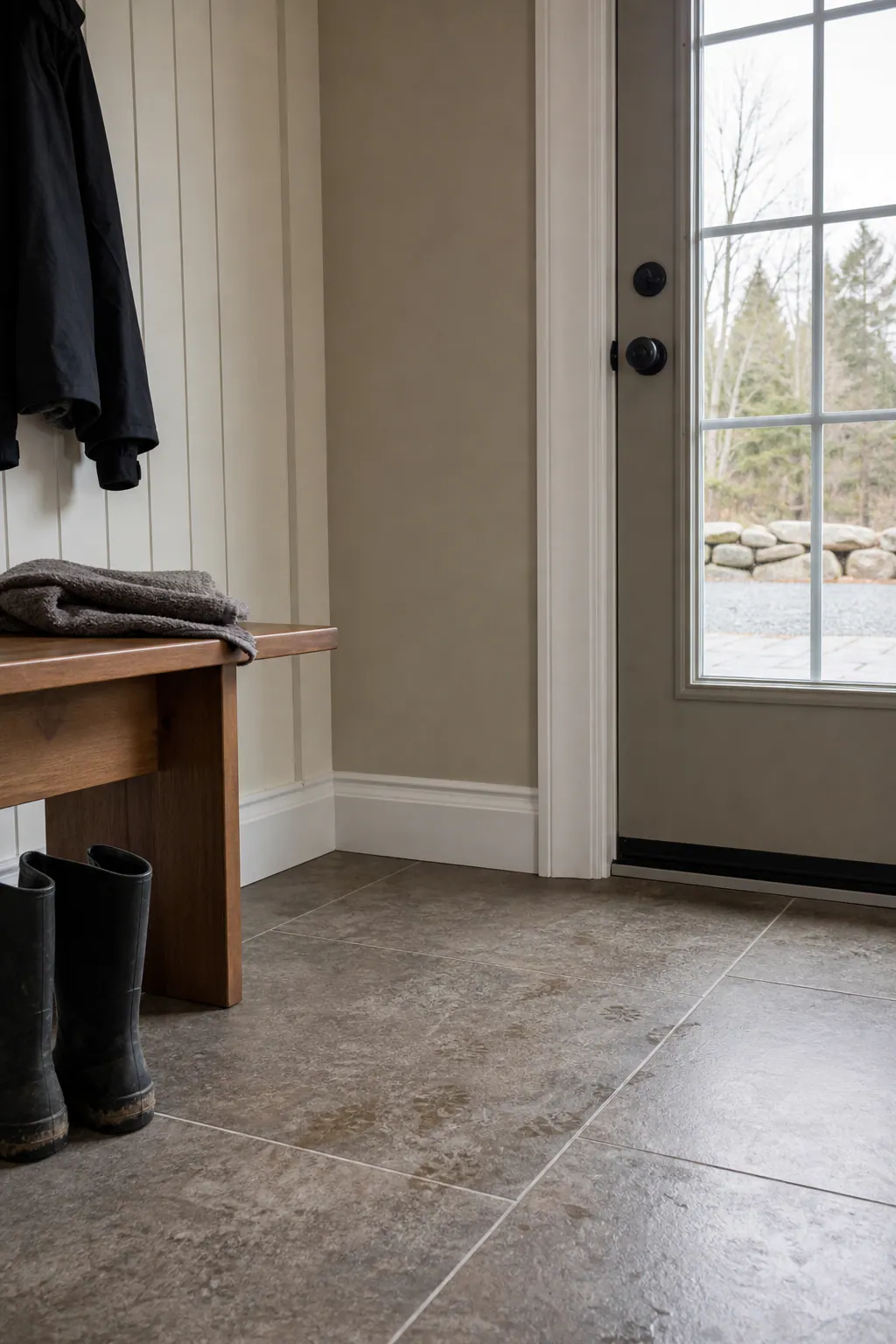
Composite trim is an engineered product made from a blend of materials rather than one solid species; its composition varies by line. Some versions aim for a more wood-like surface texture or feel than PVC. Both categories can reduce the concern that direct water contact will swell a wood-fiber core, but moisture resistance is not the same thing as an automatic fit for every room or every look.
- Choose PVC where water is the main problem. Exterior door surrounds, garage-adjacent openings, mudroom baseboards, laundry areas, and splash-prone bathroom details are sensible places to consider it. Its smooth, uniform face generally points toward a painted finish rather than stain-grade character.
- Use composite when its available texture and profile suit the design. It may be useful where a less plastic-looking surface is wanted alongside improved tolerance for damp conditions. Because composite formulations differ, its cut edges, paint requirements, and intended locations can differ too.
Neither material behaves exactly like wood during installation. PVC can expand and contract noticeably as temperatures change, especially on long exterior runs or dark-painted surfaces. Composite products also have their own movement allowances. That affects joint spacing, fastening layout, and whether a seam should be fixed or allowed to move; use the requirements for the specific product rather than copying a wood-trim approach.
Both are commonly painted when the right coating and preparation are used, but neither offers the grain, repairable carved edge, or clear-finish appeal of stain-grade wood. In a dry formal room, choosing PVC solely for moisture resistance can leave you with a surface and installation system that solve a problem the room does not have.
Trim Profiles: Flat Stock, Traditional Molding, and the Right Visual Scale
The same room can feel crisp, weighty, relaxed, or formal before the furniture arrives simply because of the trim’s silhouette. Trim profiles control that silhouette through the face of the board, its edge treatment, its width, and how far it projects from the wall. A narrow, nearly flush casing leaves a quiet outline around an opening; a wide casing built out in layers creates deeper shadows and makes the opening feel more deliberate.
Modern flat-stock trim uses plain boards or boards with a very simple routed edge. Square-edge stock has a sharp, rectilinear look, while an eased edge is gently rounded or softened so it reads cleanly without feeling harsh. Both work well in contemporary rooms, simple renovations, and spaces where walls, doors, or cabinetry already provide plenty of visual activity. The tradeoff is that very narrow flat boards can look accidental rather than intentional, particularly around substantial doors or in older rooms with taller ceilings.
For a more architectural version of simplicity, consider stepped or Craftsman-inspired assemblies. These combine flat pieces at different widths or depths: for example, a broad casing topped with a slightly projecting cap. The steps create shadow lines without curves or elaborate ornament. This approach can bridge old and new gracefully because it gives trim enough presence to suit an established house while retaining a restrained, straightforward character.
Traditional trim profiles introduce shaped details such as an ogee (an S-like curve), bead (a small rounded ridge), cove (a concave sweep), or chamfer (a clipped corner). Used singly, these details soften a board’s perimeter; combined as backbands, caps, and smaller moldings, they produce layered casings and crown with more depth. Their appeal is not decoration for its own sake: each projection catches light differently, giving formal rooms a richer frame around walls and openings.
- Match visual weight to the room. Larger rooms, higher ceilings, and more formal architecture can carry wider boards, stronger projection, and multiple layers without looking crowded.
- Let smaller spaces breathe. Low ceilings and compact rooms usually benefit from cleaner faces, modest widths, and limited projection, so the trim defines the edges without becoming the dominant feature.
- Use restraint deliberately in older homes. Flat stock can belong there when its width is generous enough for the opening and its repeated edges or stepped cap create a clear system. Thin, bare flat boards beside substantial original features are the weaker signal.
A useful final test is to view a sample at full width, held against the wall and door rather than judged face-up on a table. What matters is the shadow line from normal viewing distance: it should feel proportionate to the room, repeat a purposeful language, and support the architecture rather than compete with it.
How to Match Baseboard, Casing, Crown, and Other Trim
Think of the room’s trim as a hierarchy rather than a set of identical parts. Baseboard establishes the visual weight at floor level; door and window casing frame openings; crown finishes the ceiling line; and chair rail or wainscoting creates a middle band. Each piece can have its own job, but their edges, depth, and level of detail should appear to belong together.
Exact matches are most useful where pieces meet directly. A wainscot cap, for example, should resolve cleanly into door casing rather than stopping with an unrelated shape or thickness. Elsewhere, aim for a shared visual family: repeat an eased edge, a small bead, a square reveal, or a stepped cap. Keep projections similarly restrained or similarly layered, and let widths progress deliberately, typically a substantial baseboard, moderately wide casing, and crown sized to the ceiling rather than a collection of competing bands.
- Modern: use flat baseboard, simple flat door casing, and either no crown or a plain, lightly projecting crown. Matching square or eased edges makes the clean geometry feel intentional.
- Transitional: pair straightforward casings with a softened edge and a simple crown carrying one modest curve. The profiles need not duplicate one another; their restrained depth is the connection.
- Craftsman: combine wider flat stock with stepped headers or cap pieces. A broad baseboard and square-edged window casing reinforce the same solid, built-up language.
- Traditional: use layered casing, a shaped chair rail or wainscot cap, and crown with related bead, cove, or ogee details. Repeating one or two curves is enough; every piece need not carry every detail.
Common weak combinations usually involve conflicting scale. Ornate, deeply projecting crown over underscaled flat casing can make the ceiling feel dressed for a different room. Likewise, a heavy wainscot cap beside thin, nearly flush casing creates an awkward interruption at openings. Lay out samples together at a door, corner, and wainscot transition before committing: the goal is a clear progression of visual weight, not a perfectly matched catalog set.
Choosing the Right Material and Profile Combination for Each Room
Room use is where a trim scheme becomes specific. For a dry painted living room, paint-grade trim in MDF, finger-jointed pine, or poplar can support simple flat stock, eased edges, or a more built-up casing depending on the room’s character. Let the profile supply the style: flat and lightly detailed for modern spaces, or stepped and gently curved for a traditional setting.
- Stain-grade focal rooms: Choose solid wood when visible grain is part of the effect, then use a profile with enough width and detail to frame that natural variation without making it fussy. Clear-finished wood is a weak fit where a perfectly uniform, opaque appearance is the goal.
- Bathrooms and laundry rooms: Favor PVC or a suitable composite for areas likely to see recurring dampness, paired with uncomplicated profiles that keep the room visually clean. MDF is a poor-fit choice beside repeated splash or prolonged moisture exposure.
- High-traffic entries: Consider paint-grade wood or a moisture-tolerant alternative where baseboards will meet shoes, bags, and frequent cleaning. A broader, simpler baseboard often feels more at home here than a delicate, deeply carved profile.
- Exterior-adjacent openings: Use a material suited to the exposure conditions, then carry the interior profile family through the opening so the transition does not look accidental.
Make the selection in order: identify location and exposure; decide whether paint or visible grain is the finish goal; narrow the material; choose a profile family and scale; then coordinate baseboard, casing, crown, and wall details. The best material for trim is therefore conditional, not a universal winner, but the one that supports the room’s conditions, finish, wear demands, and architectural intent.
Plan the next step
When you are ready, request a free estimate with the rooms, trim goals, city, and available photos.
FAQs
What is the difference between paint-grade and stain-grade trim?
Paint-grade trim is intended for an opaque, uniform painted finish and can be MDF, finger-jointed pine, solid wood, or other finish-ready products. Stain-grade trim is wood selected for visible grain, color variation, and appearance under stain, oil, or clear topcoat.
Is MDF or wood better for interior trim?
MDF is better for dry interior rooms needing a smooth, grain-free painted surface, especially wide baseboards, casing, crown, and routed details. Solid wood or poplar is better where clean machining, repairable edges, and greater resistance to everyday bumps matter.
Is finger-jointed pine good for trim?
Finger-jointed pine is good for long painted runs of baseboard, casing, and simple crown because it provides straight boards while retaining wood workability. Its grain remains visible, and the finger joints can show through paint unless they are carefully filled and finished.
What trim material is best for bathrooms and laundry rooms?
PVC or a suitable composite is best for trim exposed to recurring dampness, splash, or direct water, such as bathroom details, laundry areas, mudrooms, and exterior-adjacent openings. MDF is a poor choice near tubs, showers, or unsealed wet locations because water can swell its edges and core.
How do I choose matching baseboard, casing, and crown molding profiles?
Choose profiles as one visual family by repeating details such as eased edges, square reveals, small beads, or stepped caps while keeping projection and depth similarly restrained or layered. Use substantial baseboard, moderately wide casing, and crown sized to the ceiling, then test full-width samples together at doors, corners, and wainscot transitions.