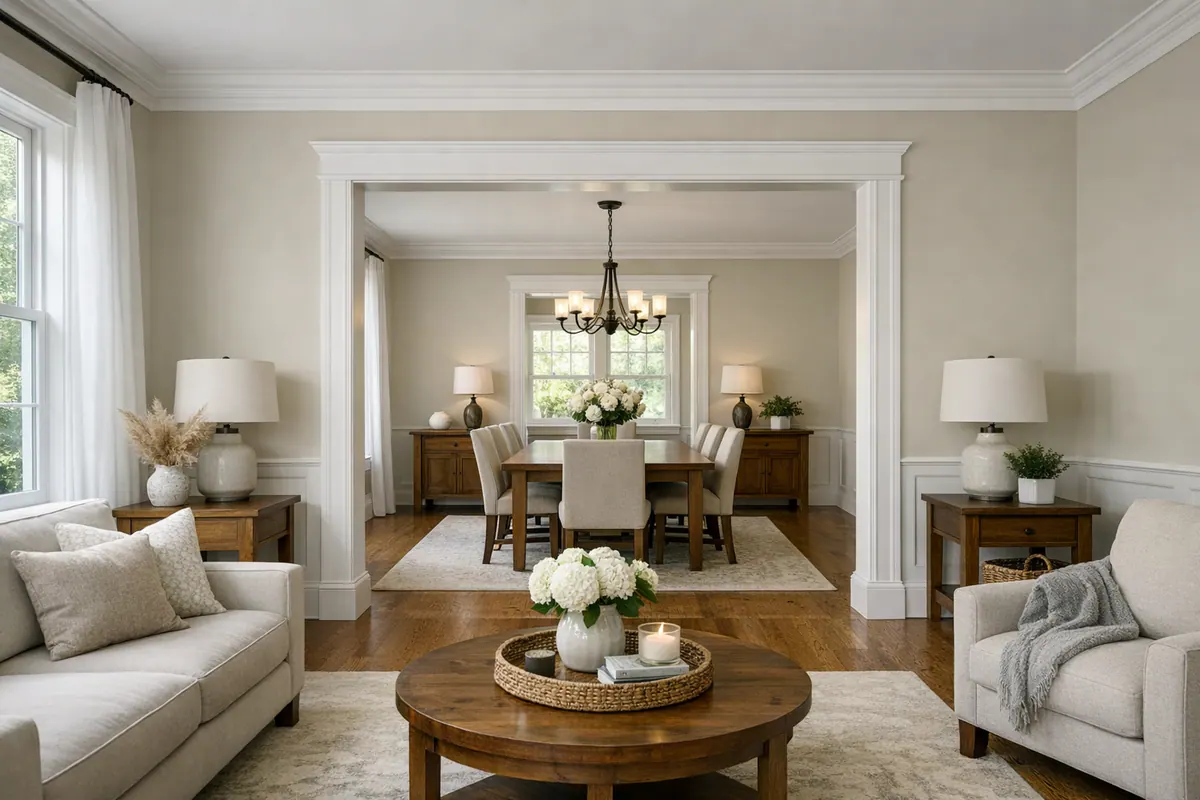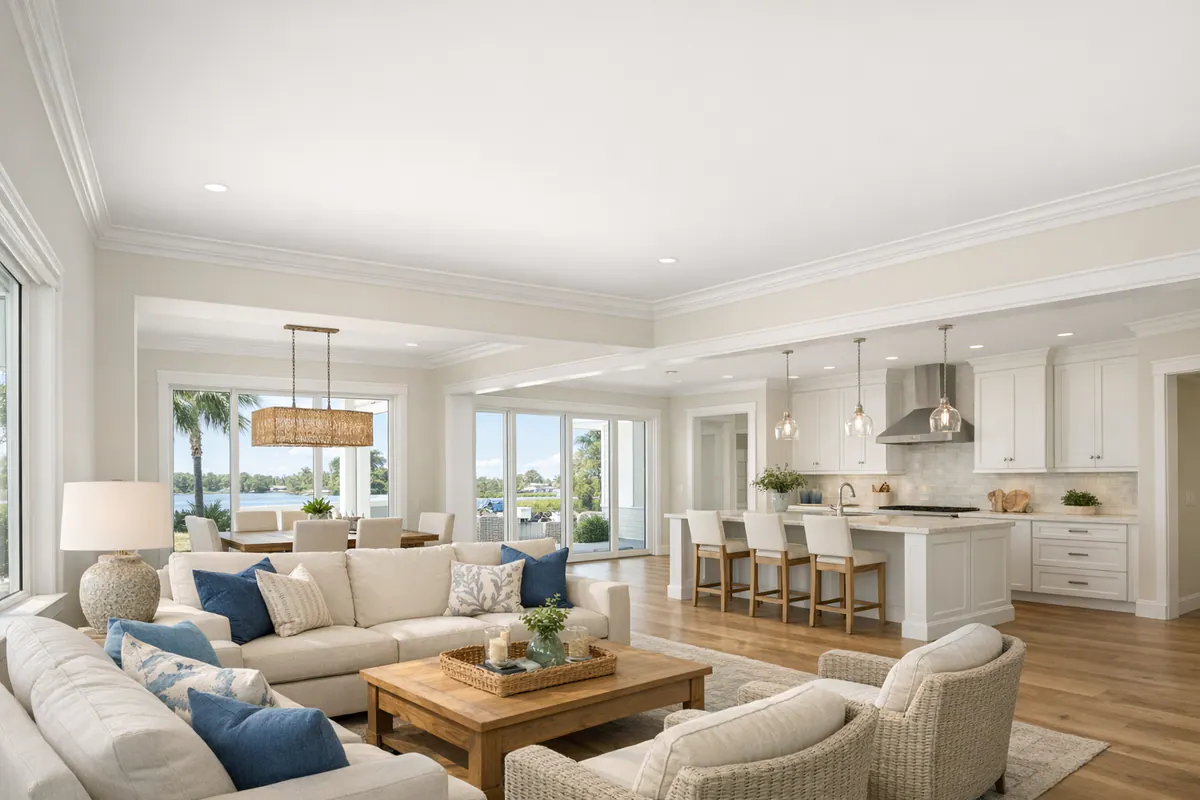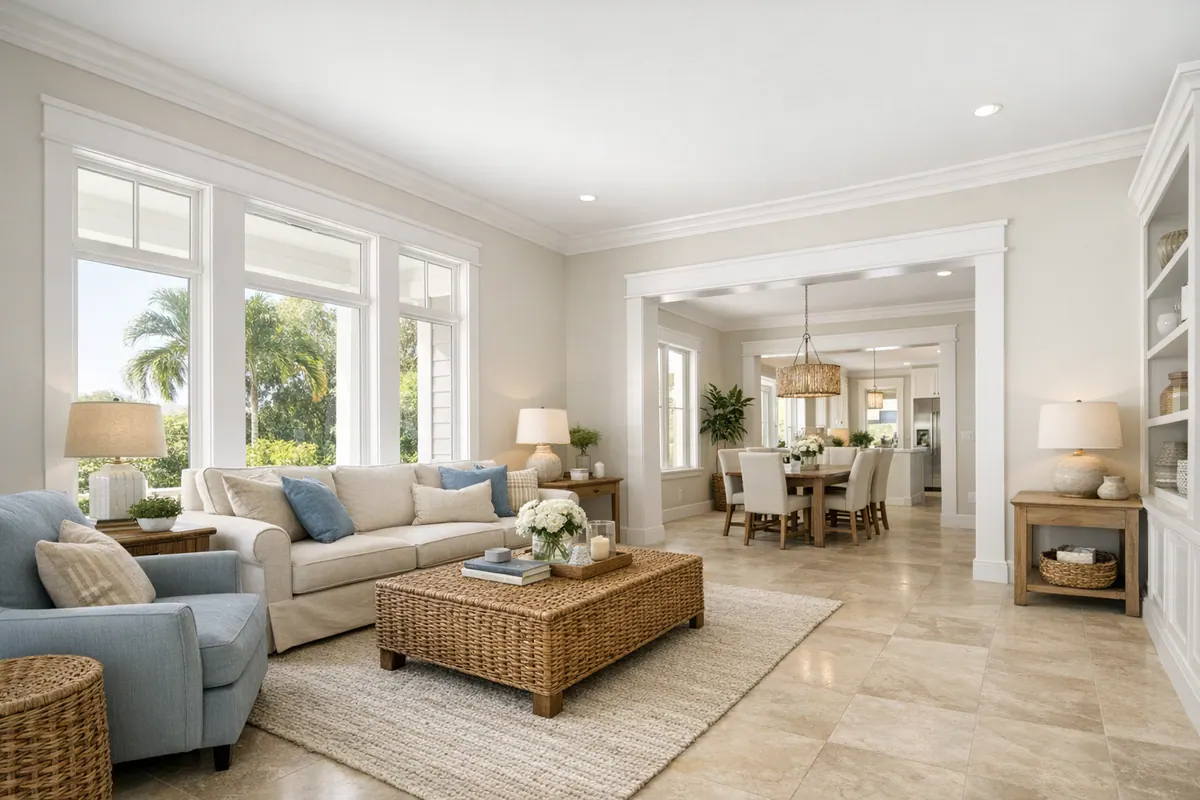
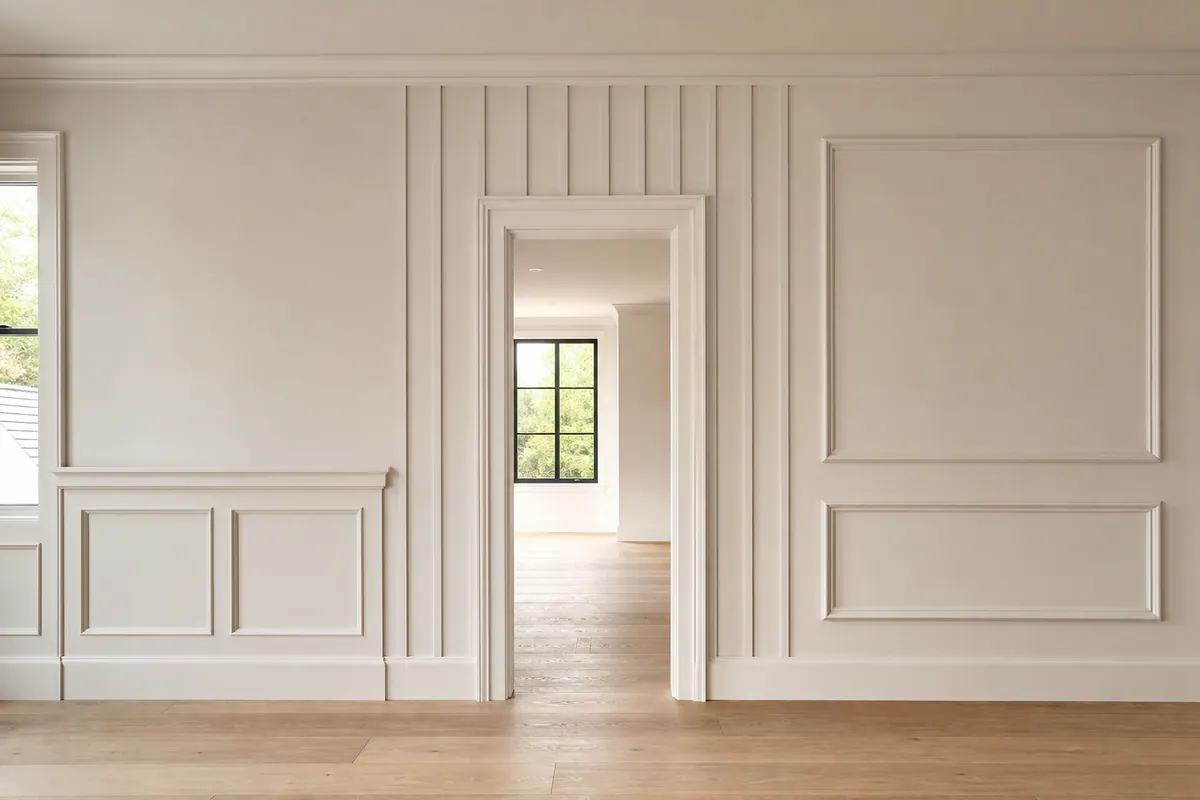

Start with what the wall needs to accomplish: a chair-height surface that can take daily scuffs, a stronger vertical pattern to organize a tall entry, or shallow decorative detail that leaves most of the wall visually open. The construction choice changes the room's visual weight, formality, material demand, and tolerance for a first-time DIY install.
| Treatment | What it is | Best fit | Weaker fit |
|---|---|---|---|
| Wainscoting | Lower-wall paneling or a built-out panel system, usually capped with a rail. | Dining rooms, halls, entries, and spaces needing a classic, substantial finish. | A very casual room or a tight budget when extensive panel work is desired. |
| Board and batten | Flat boards or panels crossed by raised vertical battens, often with a top ledge. | Mudrooms, bedrooms, entries, and tall walls that benefit from strong vertical rhythm. | Small walls already crowded by doors, windows, and outlets. |
| Picture frame molding | Applied trim arranged as shallow rectangular frames on the wall surface. | Living rooms, dining rooms, stair halls, and formal or transitional spaces. | Areas where lower-wall scuff protection is the main goal. |
Think of wainscoting as the more built-out, protective category; board and batten as the bolder linear option; and picture frames as decorative surface detail with the least coverage. Full-height battens can make a low ceiling feel more vertical, while carefully spaced picture frames bring order without making the wall feel heavy. Cost and difficulty rise with panel construction, trim profile, wall preparation, cuts around openings, and the amount of caulking and painting, not simply with the treatment name.
No option wins in every room. The useful comparison is the one that matches your room's function, proportions, existing architecture, maintenance exposure, and the level of impact you want.
Quick Verdict: Which Wall Treatment Should You Choose?
The deciding line is simple: choose the treatment whose pattern solves the room's most visible problem, lower-wall wear, an empty vertical expanse, or a lack of decorative structure.
| Treatment | Best look | Best rooms | Cost level | DIY difficulty | Durability | Formality |
|---|---|---|---|---|---|---|
| Wainscoting | Classic, paneled, substantial | Dining rooms, halls, entries | Typically medium to high | Moderate to high | Strong lower-wall coverage | Medium to high |
| Board and batten | Graphic, textured, vertical | Mudrooms, bedrooms, tall entries | Typically low to medium | Moderate | Painted trim can take everyday touch-ups | Low to medium |
| Picture frame molding | Elegant, shallow, decorative | Living rooms, dining rooms, stair halls | Typically low to medium | Moderate | Decorative, not a scuff barrier | High |
Choose wainscoting when chair backs, bags, and hallway traffic regularly meet the lower wall. A rail-and-panel composition gives the most protective, architectural result; it is the strongest choice for a traditional dining room, but a weaker bargain when a large room needs extensive detail on a limited budget.
Choose board and batten for the strongest visual impact with a relaxed feel. Repeated vertical battens organize a tall blank entry or a bedroom accent wall, while a short wall chopped up by doors, windows, and outlets can look busy. Lower-wall board and batten can be called a type of wainscoting, but its applied uprights read differently from recessed or built-out panel work.
Choose picture frame molding when the room needs polished rectangles rather than added thickness. It uses less wall coverage than the other two options, making it the easiest upgrade for a formal living room or stair hall; clean, even frame spacing matters more than adding many boxes. In a wall paneling styles comparison, it is usually the most budget-friendly route to a formal look, while battens suit bolder lines.
What Each Wall Treatment Is
The clearest way to separate these treatments is to inspect the wall face itself: a built-up panel assembly, repeated vertical strips, or narrow molding attached over a flat surface.
- Wainscoting
-
What is wainscoting? It is the broad term for a finished treatment covering the lower portion of a wall, usually from the baseboard to a top rail or chair rail. Traditional panel wainscoting is assembled from a baseboard at the floor, vertical stiles, horizontal rails, and recessed or raised panels inside that framework. The stiles and rails create actual panel openings and layered edges, rather than simply drawing a pattern on drywall. Simpler sheet-panel versions can still be wainscoting when they create a continuous lower-wall finish, but they have less profile than a rail-and-panel system.
- Board and batten
-
What is board and batten? Its defining part is the batten: a narrow vertical board or strip that covers seams between boards in traditional exterior construction, or is applied decoratively across an interior wall. Interior layouts often use painted wood boards or MDF strips spaced in a vertical row, capped by one horizontal top board; adding horizontal rails turns the pattern into a grid. The drywall or a flat backer panel may remain behind the battens, so the visual depth comes primarily from the applied strips. It becomes a type of wainscoting when that layout finishes only the lower wall, but it is not automatically the same as recessed- or raised-panel wainscoting.
- Picture frame molding
-
What is picture frame molding? It is decorative trim installed directly on drywall or plaster to create closed rectangles that resemble empty picture frames. Four pieces of molding form each box, while the existing wall remains flat and visible inside it; there is usually no separate panel construction behind the trim. Frames may sit in one row below a chair rail, stack in two rows on a taller wall, or surround a large central wall area. Because the rectangles are the feature, uneven gaps, out-of-level rails, or mismatched frame sizes stand out quickly.
The labels overlap most often on a chair-height wall. Board and batten can serve as lower-wall wainscoting, and picture frame molding below a chair rail can imitate the rhythm of a paneled room. They are not interchangeable constructions: wainscoting describes the lower-wall finish and can include true panels; board and batten relies on vertical battens to establish lines or a grid; picture frame molding outlines rectangles on the surface. That physical difference determines whether the finished wall reads as substantial paneling, a stronger linear pattern, or shallow decorative detail.
How They Look: Formality, Visual Weight, and Style
What you notice first is the shadow pattern. Deep rails and panel edges cast stronger lines, while shallow applied trim simply sketches a pattern across the wall, so the same layout can feel quietly tailored or deliberately dramatic.
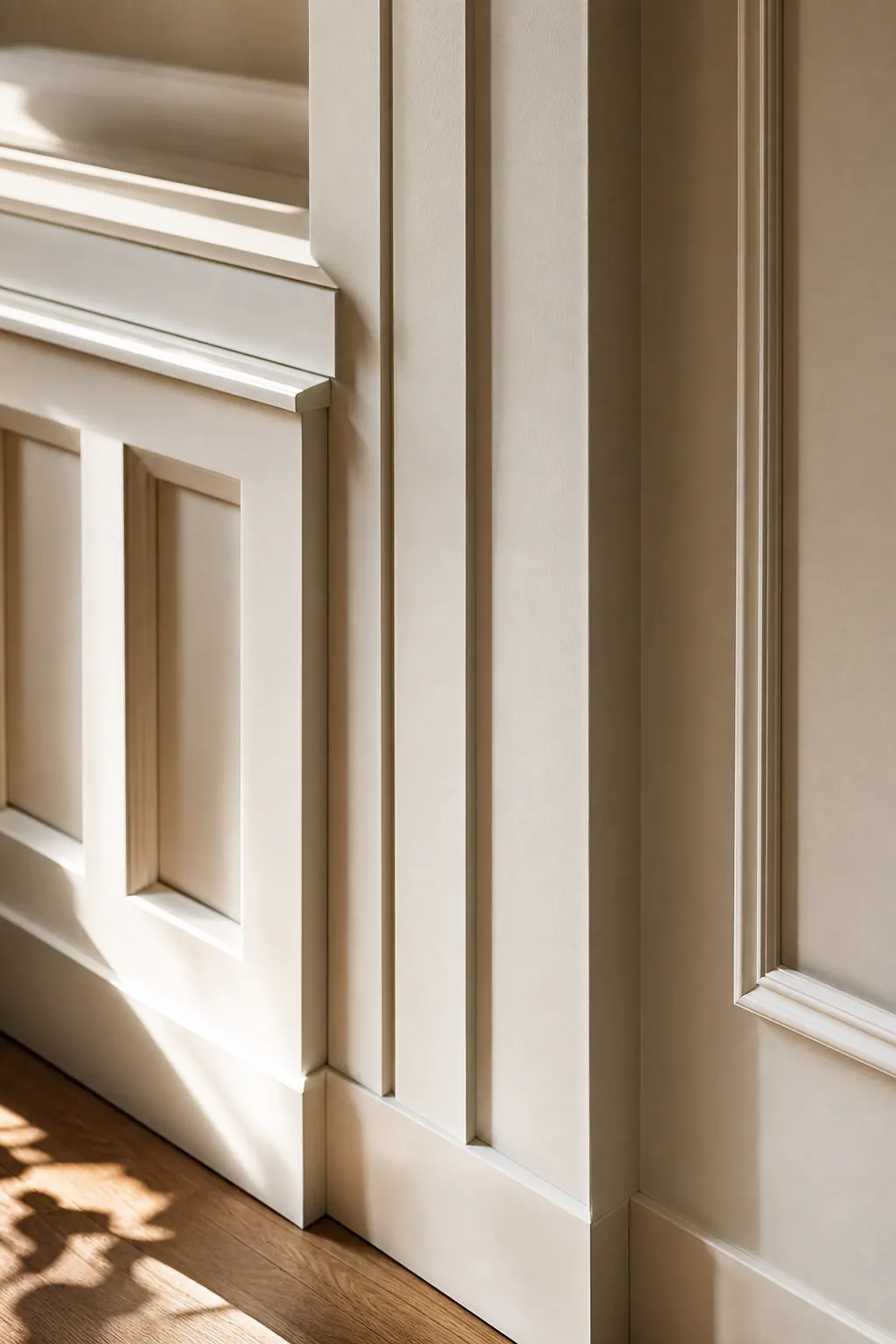
| Treatment | Visual weight | Natural style direction | When it can feel off |
|---|---|---|---|
| Traditional wainscoting | Medium to high, especially with raised panels and substantial rails | Classic, traditional, transitional, and modern classic | It can look overly ornate in a very spare room if the profiles are fussy. |
| Board and batten | Usually the strongest, because repeated vertical battens create a firm rhythm | Farmhouse, cottage, relaxed transitional, and simplified contemporary | A dense grid or heavy top rail can crowd a low ceiling or small wall. |
| Picture frame molding | Usually the lightest; the wall stays visually flat inside each outlined rectangle | Refined traditional, Parisian-inspired, and polished modern classic | Thin, tightly packed frames can look busy rather than elegant. |
Wainscoting reads as architecture because its layered millwork gives the lower wall a finished edge and meaningful depth. Recessed panels tend to feel restrained and tailored; raised panels add more shadow and formality. It is a strong match for rooms with substantial baseboards, door casings, or older-house character. In a clean-lined transitional room, simpler panel profiles and wider, calmer panels keep it from becoming period-heavy.
Board and batten makes the wall's vertical rhythm the feature. Widely spaced battens feel calmer and more contemporary; closer spacing feels more energetic and cottage-like. Its strong lines can visually organize an unremarkable wall, but that same graphic effect makes it a weaker choice when the room already has busy wallpaper, elaborate window treatments, or many interruptions.
Picture frame molding is more about proportion than bulk. Large rectangles with generous blank space read sophisticated and Parisian; smaller, evenly stacked frames lean formal and decorative. It suits a dining room, sitting room, or entry that needs polish without the visual mass of a full panel system. Uneven spacing, however, is especially conspicuous because the flat wall inside each frame acts like a backdrop.
Paint is the final volume control. Matching the trim to the wall creates subtle tonal shadow lines; crisp contrast makes every grid and joint a focal point. Dark paint, thick trim, and high contrast can make any of the three treatments feel more dramatic. For a quieter result, use a slimmer profile, fewer divisions, and a wall color that lets the detail register through light and shadow rather than color alone.
Where Each Treatment Works Best
A room's daily wear and sightlines should decide the location as much as its style. The practical difference is whether the lower wall needs a durable-looking boundary, the room benefits from vertical structure, or the wall simply needs a tailored decorative layer.
- Dining rooms: Wainscoting is often the best wall treatment for a dining room when chair backs regularly meet the wall and the room has traditional casings or a formal table-and-chandelier setup. It gives the chair zone a deliberate finish. Picture frame molding is the lighter alternative for a dining room that is used more for entertaining than hard daily traffic; it adds ceremony without closing in the room. Board and batten can work in a casual dining nook, but its assertive vertical pattern can compete with a large hutch, patterned wallpaper, or closely placed windows.
- Hallways, stairs, and entries: Wainscoting earns its keep along narrow circulation routes, where bags, hands, furniture corners, and passing traffic tend to mark the lower wall. For the best wall treatment for a hallway, choose it when the goal is both polish and a visually defined lower zone. Board and batten suits a relaxed entry or staircase, especially when hooks, a bench, or a simple ledge make the wall a working drop zone. Picture frame molding is better for a front hall or stair wall that needs refinement rather than protection; interrupted walls with many doors can make its rectangles awkward.
- Mudrooms and kids' spaces: Board and batten works well where the wall needs to feel organized and informal. Its vertical bays can align neatly with hooks, cubbies, or a bench, and the pattern has enough presence to stand up to everyday clutter. In a very busy mudroom, however, a dense batten layout plus open storage can feel visually crowded. A more built-out wainscot is a strong option when a classic finish matters, while picture frames are usually style-first here rather than a functional choice.
- Bedrooms and living rooms: For the best wall treatment for a bedroom, board and batten makes a convincing headboard-wall feature, particularly behind a simple bed. Picture frame molding is quieter across a primary bedroom or living room, where large, calm rectangles can add formality without taking attention from furnishings. Wainscoting is strongest in bedrooms with traditional architecture or where a lower-wall boundary helps anchor the room; elaborate panels can feel too formal in a compact, casual bedroom.
- Bathrooms and powder rooms: A powder room can handle board and batten's graphic character or picture frames' decorative detail because a small wall area can support a more intentional moment. In a bathroom, keep the treatment's visual density proportional to tile, mirrors, sconces, and cabinetry. Near wet zones, the finish and substrate need to suit the exposure; decorative trim alone does not make a wall water-resistant.
Small rooms call for restraint rather than no detail at all. Slimmer trim, fewer and wider divisions, lower-contrast paint, and a partial-height application leave more uninterrupted wall visible. A full grid of battens or closely spaced picture frames can turn a short wall into visual graph paper, while modest wainscoting can make a small entry or hallway feel intentionally finished. Let doors, windows, outlets, and furniture define the layout before committing to a pattern: a treatment looks strongest when its repeated lines have room to read as deliberate.
Half Height, Full Height, or Accent Wall?
Height determines whether the treatment reads as a grounded lower-wall finish, a room-shaping pattern, or a deliberate focal point. A traditional wainscot usually occupies the lower portion of the wall, often around one-third of the total height or near chair-rail level, so it creates a protective-looking base without taking over the room. Raising it toward two-thirds can feel more formal and architectural, but it needs a clear relationship to nearby door casings, windowsills, or built-ins rather than landing at an arbitrary point.
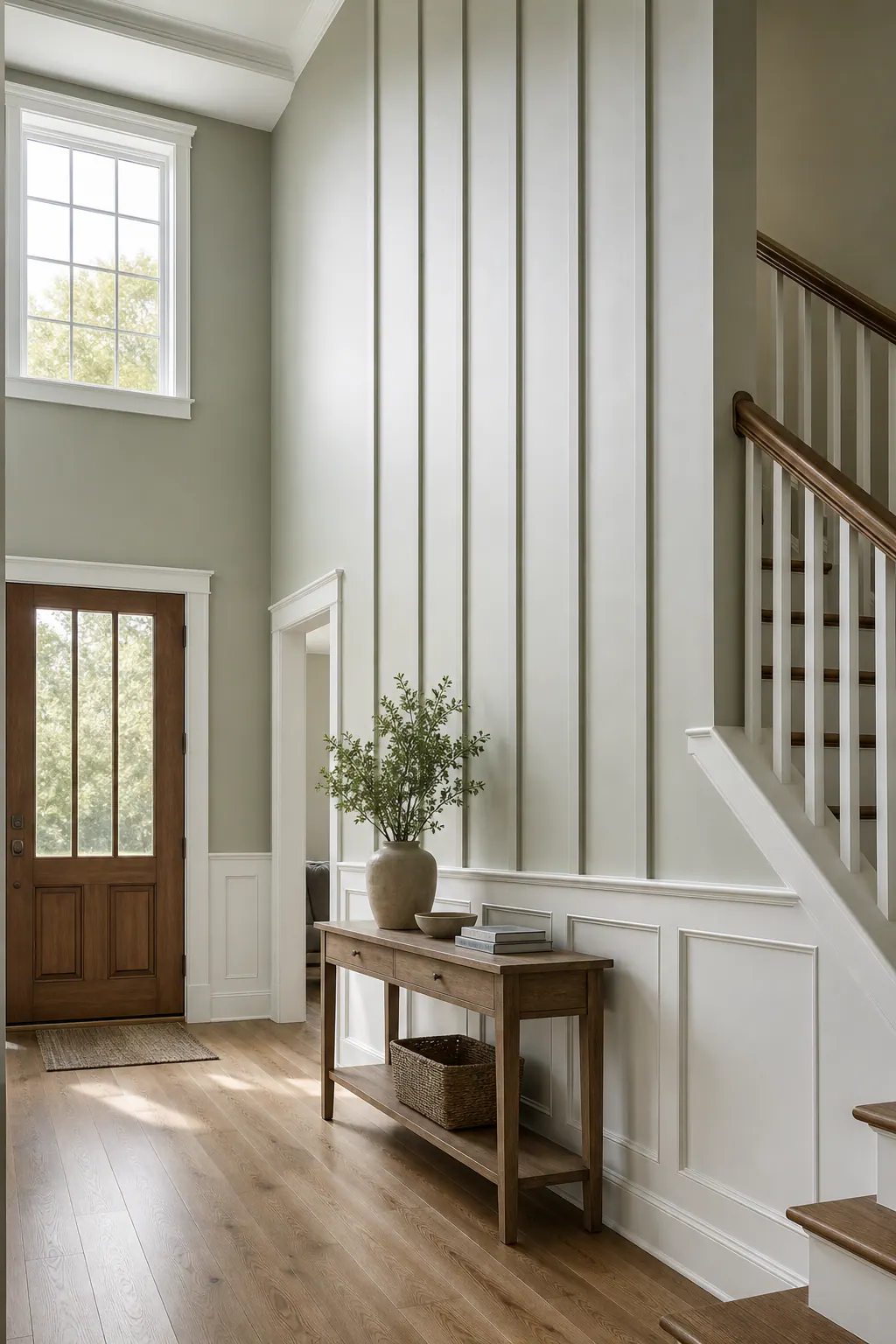
| Layout | Best use | Watch for |
|---|---|---|
| Lower-wall wrap | Wainscoting or half-height board and batten in dining rooms, halls, and rooms with chairs or benches | A top rail that cuts across windowsills or collides with furniture backs |
| Two-thirds height | Board and batten when a room needs more presence without a full grid | Too many narrow bays on a short wall |
| Full height | Board and batten for vertical drama; picture frame molding for a more tailored, stacked-panel effect | Heavy trim and contrast color in a low-ceilinged or crowded room |
| Single accent wall | A bed wall, fireplace surround, or long uninterrupted wall that needs a focal point | Extending a strong pattern onto broken walls with doors and windows |
Full height wall molding amplifies every proportion. Vertical battens can make a tall ceiling feel intentional, especially on a long wall behind a bed or sofa, while a full-wall picture-frame layout works best when rectangles can stack and align cleanly around architectural elements. Both are weaker choices when tall furniture, several openings, or a low ceiling leave only chopped-up fragments of the pattern visible.
For continuous room wrapping, let a chair rail, window sill, casing line, or countertop establish the half height wall molding line. Keep the treatment at one consistent elevation through connected walls; changing height wall by wall makes the room feel pieced together. Reserve an accent wall for maximum drama with less visual commitment, and wrap the room when the lower-wall boundary itself is the design goal.
Installation Difficulty, Cost, and Durability Compared
The price gap usually comes from how much wall must be built out, and how unforgiving the finish work will be. Picture frame molding uses the least material but asks for the neatest geometry; simple board and batten adds more linear footage and more intersections; detailed raised- or recessed-panel wainscoting combines panels, rails, stiles, caps, and more layered cuts.
| Treatment | DIY difficulty | Main cost drivers | Wear over time |
|---|---|---|---|
| Picture frame molding | Usually the simplest on flat walls with square corners | Trim profile, precise layout, miter cuts, paint prep | Decorative rather than protective; exposed wall still takes most impacts |
| Simple board and batten | Moderate | Wall coverage, battens, top rail, outlets, corners, caulk and paint | Offers a more substantial lower-wall surface, but ledges and battens can be dented |
| Detailed wainscoting | Usually the most demanding | Panel material, layered millwork, room perimeter, fitting around openings and labor | Most built-out option for a durable-looking lower-wall finish, with more joints to maintain |
Flat, smooth walls make every option easier. Texture, bowed drywall, patched areas, uneven baseboards, and out-of-square corners complicate applied trim because gaps become visible at the edges. Picture frames especially depend on consistent spacing and crisp miters: a small layout error repeats across the wall. Board and batten is more forgiving of a slightly irregular wall when its vertical pieces can be scribed or caulked, while panel-style wainscoting demands the most coordination around doors, windows, and electrical outlets.
For materials, MDF is a common painted-trim choice because it delivers a smooth, uniform profile, while wood trim can be preferable where a project needs sharper edges, more robust fastening, or a stain-grade finish. Neither material choice eliminates prep: filled nail holes, caulked seams, sanding, priming, and careful painting determine whether the assembly reads as millwork instead of separate strips.
Think of moisture and impact as separate tests. In a mudroom or busy hall, board and batten or a more substantial wainscot gives the lower wall a sacrificial finished layer that is easier to touch up than plain drywall. Picture frame molding is the weaker choice if the goal is broad scuff protection. In bathrooms, laundry areas, or entry zones that stay damp, seams, cut edges, and paint failures deserve extra attention; MDF can swell or dent when exposed to repeated moisture or hard knocks. Long term, expect occasional caulk-line repairs, paint touchups, and dusting along caps and ledges.
How to Choose the Right Wall Treatment for Your Room
Start with the room's nonnegotiables: what happens against the wall, how much visual weight the space can carry, and whether you want the treatment to feel permanent or easily changed later.
- Choose wainscoting for a classic, built-in finish in a dining room, traditional entry, or high-traffic hallway. Its rails, panels, and cap create the most substantial lower-wall presence, so it is a strong fit when protection and architectural depth matter. It is a weaker fit for a tight budget, a rough wall, or a room that may be restyled often.
- Choose board and batten when vertical lines can give a bedroom, mudroom, or casual entry more structure. It makes a bolder statement than picture frames and can extend from a practical lower-wall zone to a full-height feature wall. On a short wall or low ceiling, however, dense spacing and strong contrast can feel busy rather than uplifting.
- Choose picture frame molding for refined detail in a living room, dining room, stair hall, or bedroom where the wall does not need to absorb everyday scuffs. Applied frames preserve more flat wall and use less material, making them the flexible choice for formality without the bulk of paneling. They are less convincing where a durable lower-wall finish is the priority.
Use the room's existing lines as a reality check. A chair rail, window sill, door casing, and baseboard should make the proposed height feel intentional; a tall grid or wide cap that interrupts those features can look pasted on. Simple proportions, clean paintwork, and scale that suits the ceiling matter more than the label when pursuing the most timeless wall treatment.
For a budget-conscious DIY project, limit the treatment to one smooth focal wall and favor a simple, repeatable layout. For a more permanent renovation, invest in the details that meet corners, openings, and existing trim. This decorative wall molding comparison is most useful when the choice follows the room you actually have, not a cropped inspiration photo that hides outlets, uneven walls, and adjacent architecture.