

For homeowners planning baseboard installation in Laurel, FL, the goal is usually to make the room look finished again, not simply to cover the bottom edge of a wall. Swollen MDF near a spill, pet-chewed corners, missing sections after new flooring, dated profiles, and trim that no longer matches adjacent rooms can all make otherwise sound spaces feel incomplete.
A professional-looking replacement starts with selecting a profile that suits the room and relates sensibly to nearby door casing and existing trim. Each run must be measured, cut cleanly, fitted at corners, and fastened securely so the reveal along the wall stays consistent. Open corner joints, wavy alignment, proud fasteners, and boards forced against uneven surfaces are visible signs that the detail work was rushed.
Small wall irregularities can often be softened with a controlled caulk line, while filled nail holes and careful sanding create a paint-ready surface. Shoe molding or quarter round may be useful for a narrow flooring-edge gap; they are finishing pieces, not a cure for significant floor unevenness, moisture damage, or failing wall material. Those larger conditions deserve attention before new trim is expected to hide them.
When to Replace Baseboards, Repair Sections, or Match Existing Trim
A single damaged run does not automatically call for a whole-house trim project. An isolated replacement can make sense when the surrounding baseboards are straight, sound, and readily matchable, for example, a short piece removed for a flooring repair or a section with one localized impact mark. In that situation, the aim is to preserve the room's existing look while restoring a continuous finished edge.
Replacement becomes the more practical choice when damage is not confined to one small area: swollen edges, recurring pull-away from the wall, deep dents across several runs, missing lengths, or prior additions that look noticeably different from the original trim. A room-wide update can also look more intentional when new flooring has required removal around much of the perimeter. If several repairs would introduce different seams, colors, or profiles, replacing the visible runs in that room often creates a more cohesive result than patching them one by one.
For partial baseboard replacement in Laurel, FL, a close match involves more than choosing something that looks similar from across the room. The replacement needs the same height, thickness, and face profile, the shaped detail on the front edge, so it meets adjacent pieces without an abrupt step. Nearby door casing matters too: a taller or thicker baseboard can make the casing appear undersized or leave an awkward transition where the two trims meet. Bringing a sample or measuring an intact section helps distinguish a convincing repair from a patch that remains obvious after painting.
When the existing profile is unavailable, heavily painted over, or inconsistent from one wall to another, it may be better to replace baseboards in Laurel, FL across the full connected area rather than force a near-match. The decision is less about replacing trim for its own sake and more about whether the repaired section will belong visually with the rest of the room.
Choosing Baseboard Materials, Heights, and Profiles
Material choice affects how the trim accepts paint, handles everyday knocks, and suits the conditions at the bottom of each wall. MDF has a very smooth, uniform face that can create a clean painted look, but it is less forgiving of prolonged moisture exposure. Primed finger-jointed wood joins shorter clear pieces into a paint-grade board; it offers a wood-based alternative with a factory-primed surface, though its joints and grain still need thoughtful preparation for a seamless finish. Solid wood is useful where a natural wood appearance, a particular species, or more substantial future repair is part of the plan, but it can cost more and may show natural grain and seasonal movement beneath paint.
Other trim products can be appropriate for specific needs, such as flexible molding for a curved wall or moisture-tolerant cellular trim in an area with recurring dampness. The practical choice for new baseboards in Laurel, Florida comes from the room's exposure, the intended paint finish, the amount of wear expected near doors or furniture, and whether the new material must blend with trim already in place, not from treating one option as the answer everywhere.
Height and profile determine whether the baseboard looks proportionate rather than added as an afterthought. A simple, low-profile board can suit compact rooms or minimal door casing, while a taller board with a shaped top detail can give a larger wall more visual weight. Its thickness matters at door openings: the baseboard should terminate cleanly against the casing instead of projecting past it or leaving a conspicuous offset. When updating a connected room, repeating the same face shape and general scale across baseboards, casings, and other painted trim produces a more settled appearance.
Before trim installation in Laurel, FL, compare a sample against the actual casing, flooring, wall color, and furniture sightlines. A profile that looks appealing in a store can appear too ornate beside flat modern casing, while an overly thin board can get lost on a tall wall. Viewing the pieces together makes the budget decision clearer as well: spend where a consistent profile and finish will remain visible throughout the room, rather than paying for detail that conflicts with the surrounding interior.
What Clean Baseboard Installation Requires
A clean result begins before the first board is cut. Each wall is measured, the layout is planned to avoid awkwardly short pieces at doorways, and the wall-to-floor line is looked over for bowing, dips, loose material, or pronounced changes in height. Minor variation is common; thoughtful positioning and fastening help the baseboard follow the room in a consistent line. A substantial hump, a wide low spot, moisture damage, or a badly out-of-plane wall deserves attention first, because trim should finish a sound surface rather than disguise a major underlying problem.
Long runs are cut and test-fitted so joints land neatly and the face of the profile stays aligned from piece to piece. Where two boards meet on a straight wall, a tight, well-supported seam is less noticeable than a loose butt joint placed in a highly visible area. At an outside corner, two mitered cuts meet to wrap the projecting edge; the goal is a crisp corner with both profile faces lining up. Inside corners often benefit from coping, where the end of one board is shaped to fit the face of the adjoining profile. That fit can stay tighter when a room corner is not perfectly square.
A baseboard installer in Laurel, FL also has to fasten the trim without leaving it pulled away or visibly over-nailed. Suitable finish nails secure the board at framing or other solid backing while leaving small holes that can later be filled. Construction adhesive can be useful selectively when it helps a board sit firmly against a sound surface, but it is not a substitute for proper attachment or a cure for unstable, damaged, or severely uneven walls.
Dry-fitting before fastening makes it possible to adjust a joint, trim a high spot, or reposition a seam instead of forcing the board into place. The stronger visual signals are simple: consistent contact along the wall, tight corners, aligned profile details, and seams that do not open up across the face. Caulk and finish work refine those small transitions afterward; they should not be carrying the burden of a poor layout or a board that never fit correctly.
Addressing Wall-to-Floor Gaps, Uneven Floors, and Flooring Transitions
A narrow space at the bottom of a wall is not always a defect. Many flooring systems are installed with a perimeter allowance for normal movement, and the baseboard is positioned to conceal that edge while leaving the flooring free to move as intended. A clean result shows a continuous finished line rather than exposed flooring-edge gaps; a wide or changing gap from one part of the wall to another points to a floor or wall condition that deserves closer evaluation.
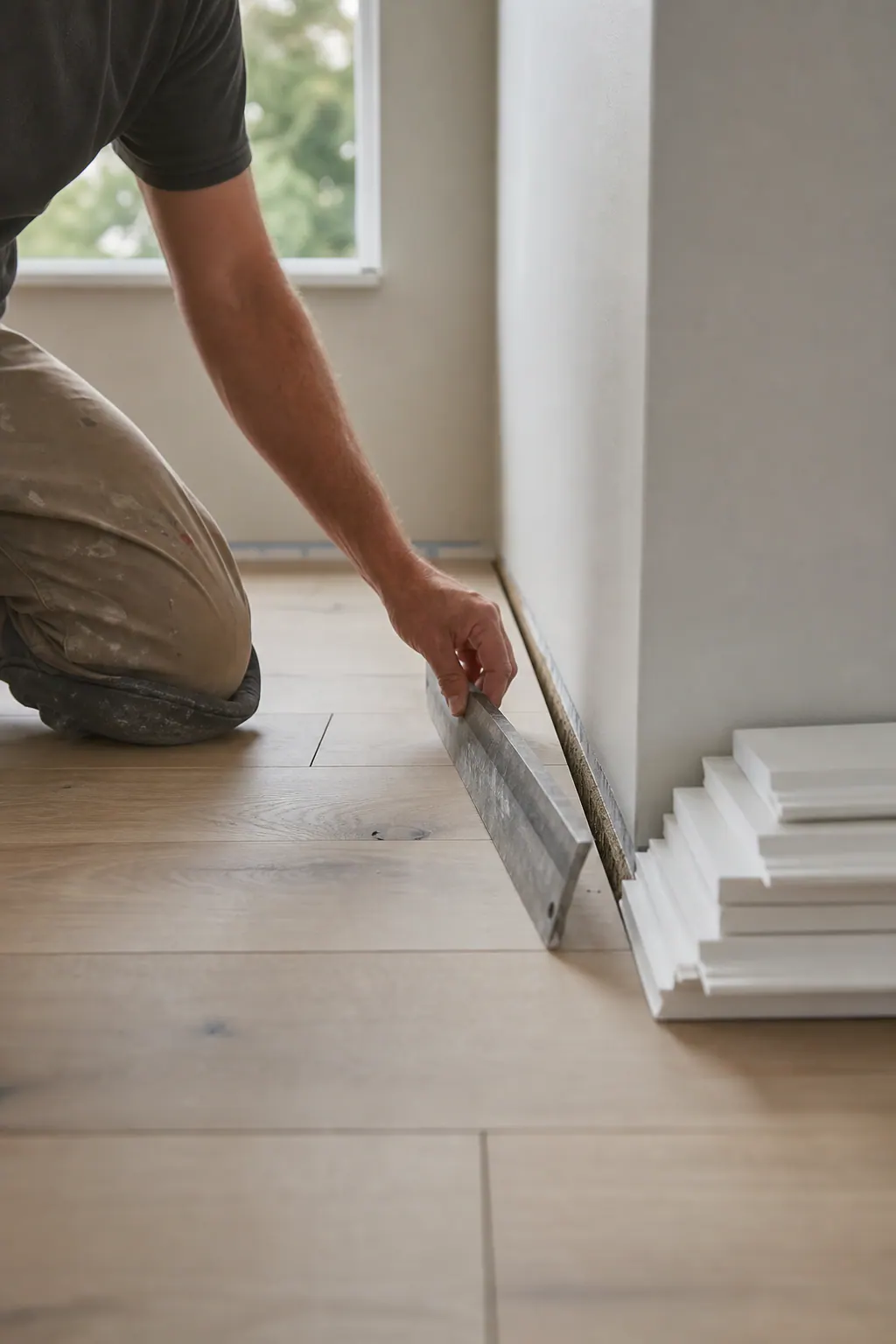
Floor flatness changes how the bottom edge of the trim reads. A slight dip or rise may leave a small, localized opening beneath an otherwise straight baseboard. An irregular wall can also create a changing shadow line at the top. These are different conditions: the first concerns the floor-to-trim contact, while the second affects the wall-to-trim contact. Neither is improved by forcing a rigid board into a pronounced curve or filling a large void with caulk.
Shoe molding is a small, narrow trim piece with a relatively low profile that runs along the baseboard at the floor. Quarter round is similarly used at that joint, but its face is a true quarter-circle and generally looks fuller and more rounded. Unlike baseboard, which creates the main visual border at the base of the wall, these pieces are finishing details. They can neatly cover a modest expansion space, a minor floor variation, or a narrow edge at a flooring transition without changing the main baseboard profile.
For baseboards in Laurel, FL, shoe molding can be a sensible choice after new flooring when the existing baseboard remains in place and the new floor leaves a slim perimeter gap. It should sit consistently and complement the room's casing and baseboard style. A large gap, soft or stained material, recurring swelling, or a floor that noticeably slopes calls for attention to the underlying substrate or moisture condition instead of a wider trim strip meant to hide it.
Caulking, Nail-Hole Filling, and Paint-Ready Baseboard Finishing
Finishing is where separate boards begin to read as one continuous trim line. At the wall-to-baseboard joint, a narrow, controlled bead of paintable caulk can soften small shadows caused by minor wall texture or slight surface variation. The goal is a crisp transition, not a thick ridge of material. A smooth, even line that follows the top edge is a good sign; heavy caulk smeared onto the wall or a joint that still looks uneven after caulking is not.
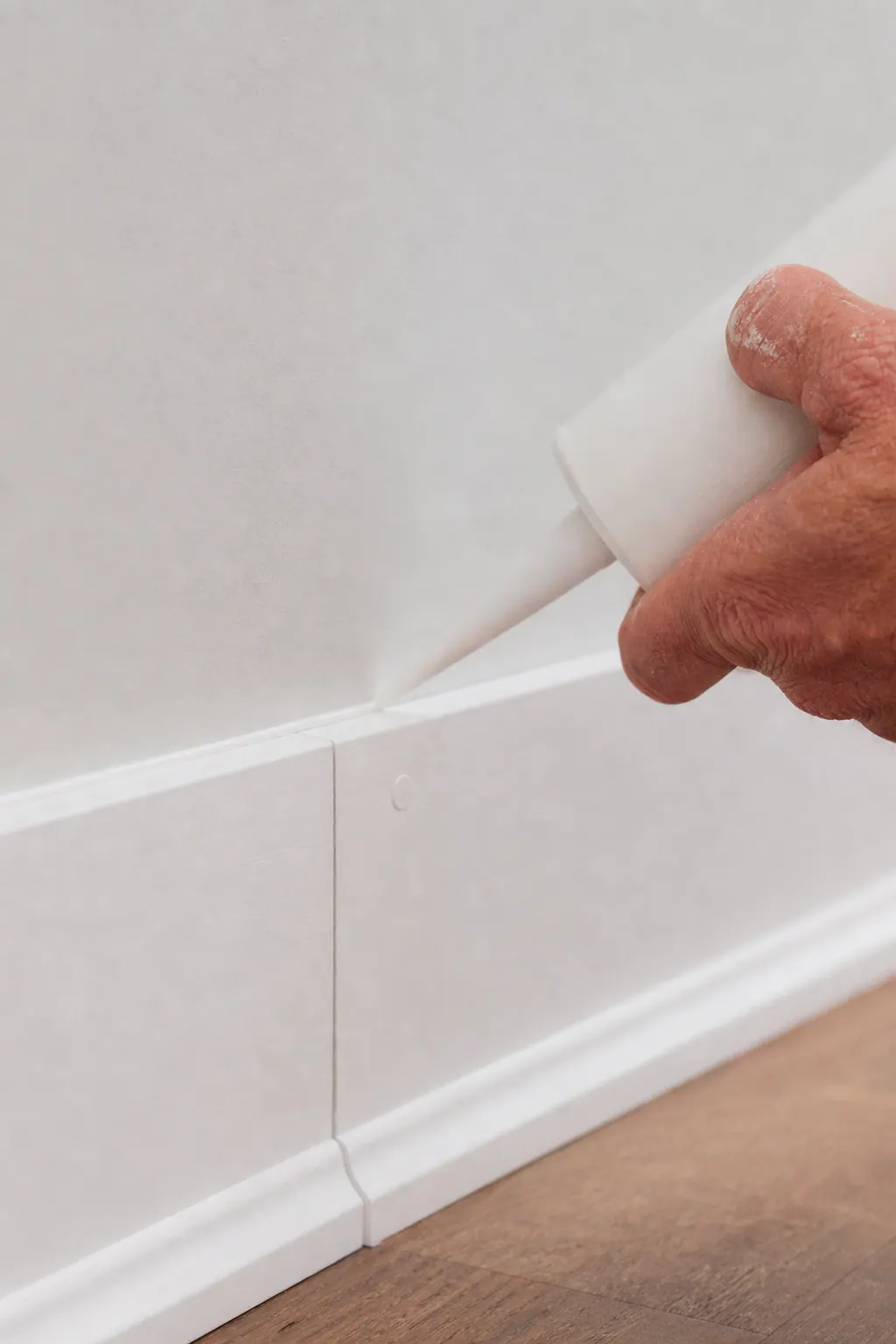
Caulk has a limited job. It can bridge a modest stationary gap between the wall and trim, but it should not be used to pack a wide opening, hide a wall that is substantially out of plane, or compensate for movement, moisture damage, or loose material. Those conditions can cause a filled joint to crack, separate, or remain visibly irregular.
After fastening, recessed nail holes and small seams are filled with a paintable filler. Once it has dried, the prepared spots are sanded or smoothed flush with the face of the baseboard so they do not telegraph through the final coat. The usual finishing sequence is to fill and smooth the holes and seams, apply caulk where the wall-to-trim transition calls for it, then prime repaired areas as needed before paint.
Paint touch-up needs to be planned rather than assumed invisible. Even the same color may read differently when the existing coating has aged, is dirty, or has a different sheen. Flat, eggshell, satin, and semi-gloss finishes reflect light differently, so a small patch can stand out along a long baseboard run. For trim installation in Laurel, FL, painting the full newly installed length, or a complete connected wall section, often creates a more uniform result than scattering spot repairs across old and new trim.
Baseboard Replacement in Laurel and Nearby Sarasota County Communities
After the finish is planned, project details make the next conversation more useful. For baseboard replacement in Laurel, FL, share approximate room measurements, clear photos of the existing baseboard and nearby door casing, and a note about whether the goal is a close profile match or a coordinated update across connected spaces. A straight-on photo of the profile and a photo showing its height beside the casing can reveal differences that a room-wide image misses.
Flooring details matter, too: identify whether the floor is tile, laminate, vinyl, hardwood, or carpet; whether it is newly installed; and where gaps, height changes, or transition pieces occur. Photos of swollen sections, missing runs, loose trim, damaged corners, and prior patching help distinguish selective replacement from new trim after flooring or a broader refresh. Include the number of affected walls and whether paint matching is part of the scope.
This page identifies service for Laurel, FL and does not list additional Sarasota County communities. Homeowners planning baseboard installation in Laurel, FL can begin a more informed project discussion by sharing those photos, measurements, flooring details, and the visible extent of damaged or missing trim.
Plan the next step
Compare the broader Baseboard Installation service.
Review the Laurel, FL service area for local planning context.
When you are ready, request a free estimate with the rooms, trim goals, city, and available photos.
FAQs
What is the difference between baseboard and shoe molding or quarter round?
Baseboard is the main trim board that creates the finished border along the bottom of a wall. Shoe molding is a narrow, low-profile finishing piece, while quarter round has a fuller quarter-circle face; both can cover modest flooring-edge gaps.
Can new baseboards cover gaps between the wall and floor?
Baseboards can conceal the narrow perimeter allowance left for normal flooring movement. A wide or changing gap, noticeable floor slope, soft material, or moisture damage should be corrected at the underlying floor or wall rather than hidden with wider trim.
Are MDF baseboards a good choice for homes in Laurel, FL?
MDF baseboards provide a smooth, uniform surface for a clean painted finish. They are less suitable where prolonged moisture exposure is likely because swollen MDF can be difficult to repair convincingly.
Do new baseboards need caulking and nail-hole filling before painting?
Yes, recessed finish-nail holes and small seams should be filled, dried, and sanded flush before painting. Use a narrow bead of paintable caulk only for small wall-to-trim gaps, not to fill wide openings or conceal uneven walls.
Should I repair damaged baseboards or replace all the trim in a room?
Repair or replace only the damaged section when surrounding baseboards are straight, sound, and available in the same height, thickness, and face profile. Replace the visible runs in a room when there are swollen edges, repeated pull-away, missing lengths, widespread dents, or several repairs that would create mismatched seams and profiles.