

Professional Baseboard Installation for Venice, FL Homes
Baseboards do more than draw a clean line around a room. They shield the lower edge of the wall from everyday scuffs, bridge the small perimeter gap left beside flooring, and create a visual connection between floors, walls, door casing, and other interior trim.
That finishing role becomes obvious when the existing trim is working against the room: swollen or chipped sections, open corner joints, thin builder-grade boards that disappear beside updated finishes, or baseboards left mismatched after new flooring. A loose piece or a caulk line that has pulled away can make an otherwise polished room feel unfinished.
Professional baseboard installation in Venice, FL is especially useful when the issue is more than one damaged length. Before recommending a repair or replacement, a trim carpenter can look at the flooring edge, wall and floor variation, existing casing, transition areas, and the condition of the old material. That assessment helps distinguish a small localized fix from a change that deserves a coordinated room-by-room plan.
A well-planned installation is not simply new boards nailed to the wall. The trim should sit consistently along irregular surfaces, meet cleanly at corners and doorways, and leave a paint-ready finish rather than relying on thick caulk to disguise poor fit. For homeowners updating dated interiors or correcting flooring-related gaps, experienced baseboard installers in Venice, FL can make the lower wall line look intentional again.
When Baseboard Replacement Makes More Sense Than Repair
A nick from furniture, a small nail hole, or one separated joint can often be repaired without disturbing an entire wall of trim. A sound board with crisp edges can be filled, sanded, recaulked at the wall, and repainted; the good signal is that it still sits flat and its profile matches the neighboring lengths.
Replacement becomes the cleaner long-term choice when the damage affects the board's shape or consistency. Water-related swelling, soft or crumbling lower edges, recurring chips in the same traffic area, heavy layers of old paint that blur the profile, and missing sections all make a patch more visible and less durable. This does not mean every piece of MDF baseboard must come out: a dry, firmly attached section with only surface damage may still be a repair candidate. Once an edge has expanded or deteriorated, though, replacement usually produces a straighter paint line.
- Profile mismatch: If a repaired length has a different height, thickness, or top detail than the rest of the room, replacing the run avoids a conspicuous interruption, particularly where thin builder-grade baseboards meet updated finishes.
- Flooring changes: New flooring can leave old trim undersized, damaged during removal, or unable to cover the perimeter edge cleanly. Taking it off also exposes the wall base and transitions so they can be addressed before new trim is fitted.
- Whole-home consistency: After a renovation, replacing room-by-room leftovers with one coordinated profile can make doorways and connected spaces read as part of the same update.
For baseboard replacement in Venice, FL, the useful decision is not simply "repair or replace." It is whether the existing trim can be made visually consistent with the room after preparation and paint, or whether removal creates a better foundation for a lasting, coordinated result.
Choosing Baseboard Height, Profiles, and Materials
Scale is the best starting point for choosing new trim. Standard-height baseboards keep compact rooms and lower ceilings from feeling crowded, while taller boards give rooms with more vertical space a stronger finished edge. A tall profile can also make an open living area feel more intentional, but it should not overpower narrow door casing or a modest ceiling line. Looking at a sample beside the existing casing, crown molding, wall color, and flooring is more useful than choosing height from a catalog image alone.
Flat-stock trim is a square-edged, minimally detailed board that suits clean-lined, contemporary interiors. Its simplicity creates a crisp wall-to-floor transition, but it also makes irregular walls, wavy floors, and inconsistent seams easier to notice. Decorative baseboard profiles introduce a shaped top edge or layered detail, which can better echo traditional door trim and soften the transition in homes with more classic character. A colonial baseboard profile, for example, brings more shadow lines and visual detail than flat stock; it works best when nearby casing has enough presence to support it rather than making the room look like a mix of unrelated trim styles.
- Paint-grade MDF: A smooth, uniform option for an opaque painted finish. It can be a sensible choice in dry interior areas when the goal is a consistent, contemporary paint line. Its suitability depends on the room and exposure, since moisture resistance is not the same as waterproofing.
- Primed wood trim: A paintable material that can be shaped into more detailed profiles and used where a natural wood substrate is preferred. It still needs careful preparation, filled fastener holes, and a finish coat that makes separate lengths read as one continuous installation.
- Stained wood trim: Chosen when visible grain is part of the design. Color and grain variation become features rather than something paint hides, so it is most convincing beside compatible wood doors, flooring, or other stained architectural elements.
Flooring matters as much as style. Light tile or wide-plank flooring often pairs well with a simple painted board, while a room with traditional casing or crown may call for a more substantial profile. For baseboard installation Venice FL homeowners should also consider wall condition before selecting a sharp-edged design: the cleaner and flatter the surfaces, the more convincing flat stock will look. A trim carpenter can compare samples in the actual room and select a height, profile, and material that belong together rather than treating each choice as separate.
Flooring Transitions, Shoe Molding, and Uneven Wall Details
The line where flooring meets the wall often decides whether new trim looks intentional or merely covers an edge. Before boards are cut, the perimeter should be measured at several points, not just at the corners, to reveal a floor that rises, dips, or runs out of level, along with walls that bow inward or outward. A small, consistent gap can usually be handled cleanly; a gap that changes noticeably along one wall calls for a fitting decision rather than a blanket trim solution.
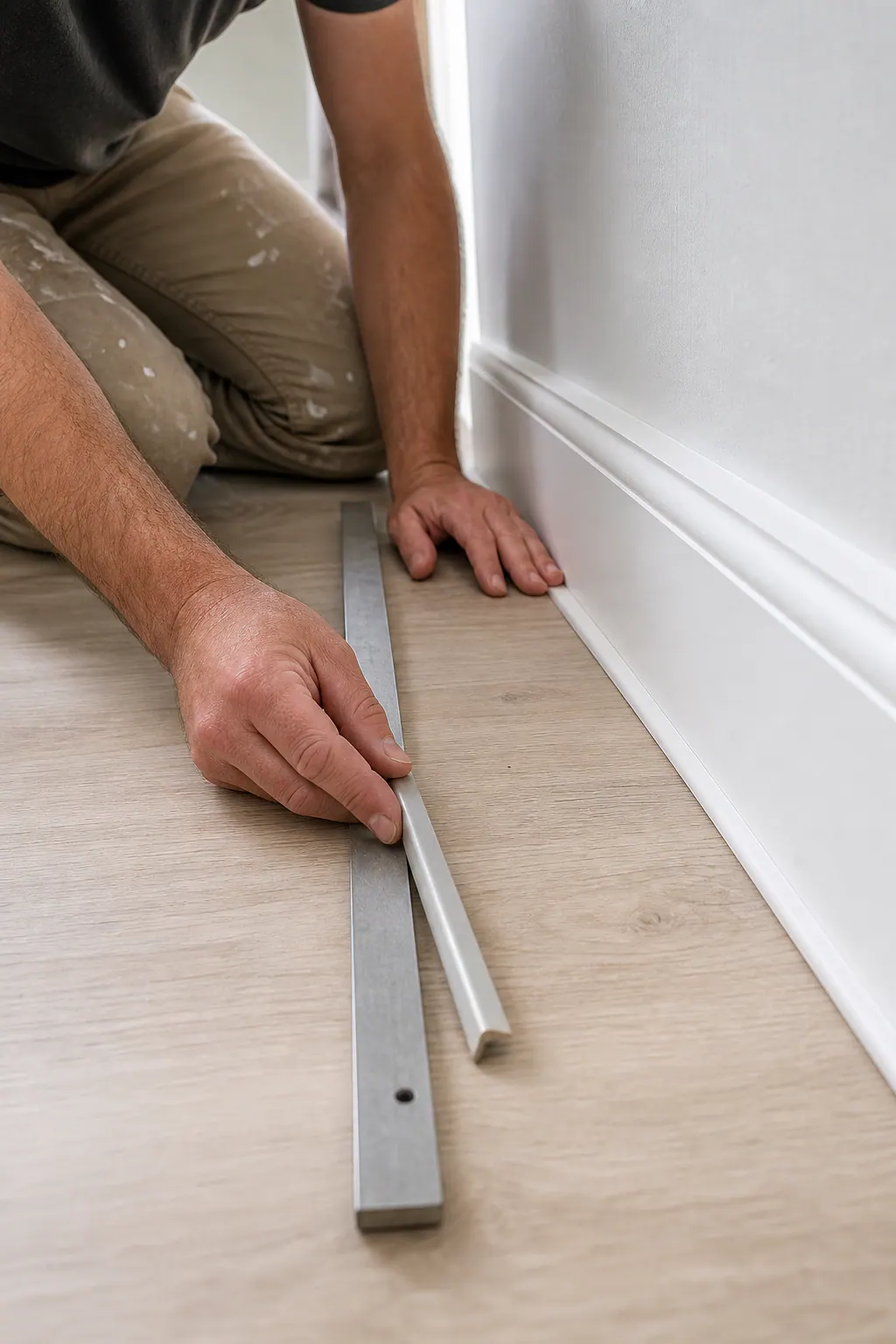
A flooring expansion gap is the small perimeter space many floating floor systems need so the floor can move without pressing against the wall. Baseboard can conceal that space while staying attached to the wall, not pinning the floor in place. Tile, nailed wood, and other flooring assemblies can present different edge conditions, so the right detail depends on the floor already in the room and the width and consistency of its exposed perimeter gap.
- Baseboard only creates the cleanest, least layered look when the floor edge sits close enough to the wall and the baseboard follows the surface without conspicuous openings.
- Shoe molding is a narrow, low-profile strip installed at the baseboard's lower edge. It can cover minor variations between floor and wall while preserving the main baseboard profile.
- Quarter round has a fuller quarter-circle face. It covers a similar type of small gap but reads heavier and more rounded, making it a different visual choice rather than an interchangeable detail.
Shoe molding should not be assumed in every room. It is useful when a new floor leaves a modest, uneven reveal beneath otherwise well-fitted baseboards; it is a weak fix when it is being asked to hide broad gaps, damaged flooring edges, or a poorly planned layout. At door jambs, the trim should terminate cleanly against the casing or be coordinated with an undercut floor edge so the doorway does not become a stack of awkward, competing lines.
An on-site layout lets a trim carpenter identify where a wall needs scribing, where a floor variation can be eased visually, and where a simple baseboard-only detail will look sharper than adding another molding.
What Clean Baseboard Installation and Finishing Should Include
The finish work is where a measured layout becomes a convincing continuous line around the room. Old trim should come off carefully so drywall paper, wall texture, and adjacent casing are disturbed as little as possible; any small removal damage needs patching and smoothing before the new boards go up. Skipping that repair can leave a rippled edge or a visible break in the wall's shadow line above the baseboard.
Each run should be measured and cut for its actual location rather than treated as a repeatable length. Miter joints bring two boards together at an outside corner with matching angled cuts, creating a crisp wrapped edge instead of an exposed end grain. On inside corners, coping inside corners means shaping the end of one board to fit the face of the adjoining profile. That approach can keep an inside joint looking tighter when an older corner is not perfectly square.
- Secure fastening: Boards should be held firmly against the wall at appropriate attachment points so they do not sit proud, flex noticeably, or leave changing gaps along their top edge.
- Filled fastener holes: Nail holes need filler that is leveled and sanded, not simply painted over. Under a painted finish, a clean close-up should show an even face rather than rows of dimples or raised patches.
- Controlled caulk lines: Paintable caulk softens the small seam where trim meets wall, helping the wall and baseboard read as one finished assembly. It should be a narrow, smooth line, not a thick bead used to mask a poor fit.
- Paint preparation: Sanding dust, filler residue, and rough cut edges should be addressed before final coating. A paint-ready scope differs from installation-only work: it includes prepared joints and surfaces, while final paint application should be clearly defined in the project scope.
For interior trim in Venice, FL, the useful visual checkpoint is consistency: corners close cleanly, the top edge maintains an intentional reveal against the wall, and paint coverage does not call attention to patched holes, caulk smears, or uneven texture. Those restrained details are what allow the profile, not the installation, to be the part people notice.
Whole-Home Baseboard Upgrades and Matching Existing Trim
A whole-home trim plan begins at the door openings, not with the longest wall. Hold proposed baseboard samples beside existing door casing to compare height, edge detail, and paint color. An exact profile match can preserve a traditional interior, but it is not always necessary: a simple, similarly scaled baseboard can complement detailed casing without making the rooms feel pieced together. The weak signal is a tall, ornate baseboard abruptly meeting thin, plain casing at every doorway.
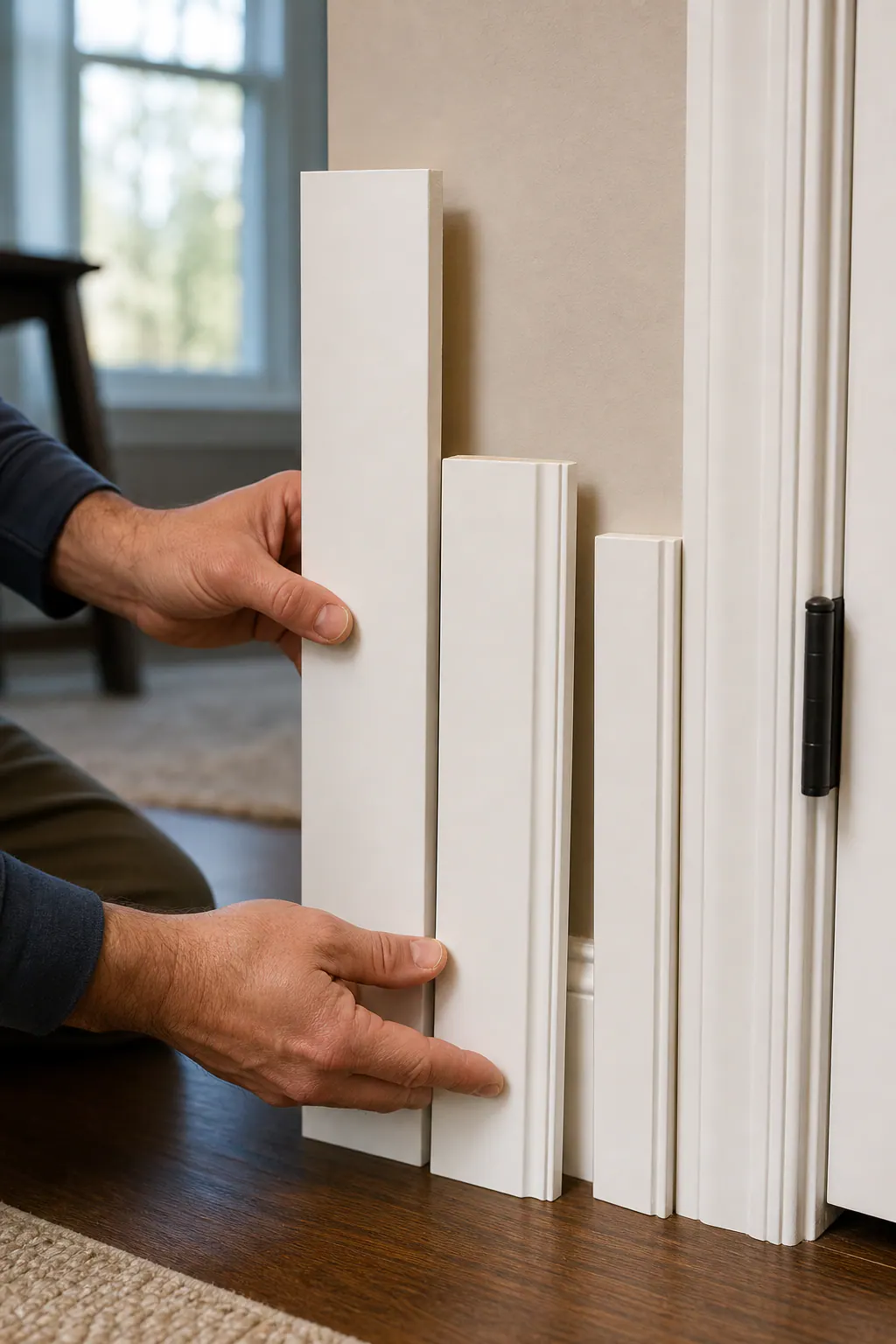
Related trim belongs in the scope when it resolves that imbalance. Base cap molding is a smaller decorative piece fitted along the top of a plain baseboard to create more visual depth; it can help a flat board relate to more substantial casing or crown. Updating casing may make more sense when its profile, damage, or color would remain the obvious outlier after new baseboards are installed. A trim carpenter Venice FL homeowners hire for this work can use sample combinations to settle the transition before materials are ordered.
For occupied homes, the work can be organized room by room: move furnishings from one space, remove and replace trim, complete surface preparation, then return the room to use before progressing. Hallways, connected living areas, and doorways deserve early planning because they visually link the separate phases. This approach lets homeowners install new baseboards Venice FL-wide in manageable stages while keeping the finished profile, height, and paint plan consistent from room to room.
Plan Your Venice Baseboard Installation Project
It helps to arrive with a few notes, not a fully designed plan. Share which rooms need attention and whether you are dealing with a damaged run, trim removed for new flooring, or a coordinated update across the home. Photos of the existing baseboards, door casing, flooring edges, and any bowed walls or uneven areas give the conversation a useful starting point.
- Choose the general look: taller trim adds presence, while clean flat-stock keeps the line simple and modern.
- Consider the finish: paint-grade material suits a painted look, while wood is an option when a stained appearance is part of the room's design.
- Point out flooring transitions and gaps so shoe molding, if it is needed, is treated as a neat finishing detail rather than a cover-up.
- Set the scope clearly: one-room replacement, flooring-related baseboard work, or a room-by-room whole-home update.
A baseboard contractor Venice FL homeowners speak with can use those details to assess the trim condition, style, materials, wall fit, and work sequence that suit the space. Request a consultation for Venice FL baseboard installation and leave with a clear plan for the work you want completed.
Plan the next step
Compare the broader Baseboard Installation service.
Review the Venice, FL service area for local planning context.
When you are ready, request a free estimate with the rooms, trim goals, city, and available photos.
FAQs
Should I replace baseboards when installing new flooring?
Replace baseboards when new flooring leaves the old trim undersized, damages it during removal, or creates an exposed perimeter gap that the existing boards cannot cover cleanly. Removing the old trim also allows the wall base and flooring transitions to be repaired before new boards are fitted.
What size baseboards look best in a Florida home?
Choose baseboard height based on room scale: standard-height boards suit compact rooms and lower ceilings, while taller boards add presence in rooms with more vertical space. Compare samples beside existing door casing, crown molding, flooring, and wall color so the trim does not overpower nearby details.
Are MDF baseboards a good choice for Venice, FL homes?
Paint-grade MDF provides a smooth, uniform surface for opaque painted finishes and works well in dry interior rooms. It is moisture-resistant rather than waterproof, so swollen, wet, or high-exposure areas may require a more suitable material.
What is the difference between shoe molding and quarter round?
Shoe molding is a narrow, low-profile strip installed along the bottom of baseboard to cover minor floor-to-wall variations. Quarter round covers similar small gaps but has a fuller quarter-circle face, creating a heavier and more rounded appearance.
Do I need a trim carpenter for baseboard installation in Venice, FL?
A trim carpenter is especially useful when walls bow, floors are uneven, new flooring has left inconsistent gaps, or multiple rooms need coordinated trim. Professional fitting includes measuring each run, using miter joints at outside corners, coping inside corners, filling fastener holes, and applying narrow paintable caulk lines.