
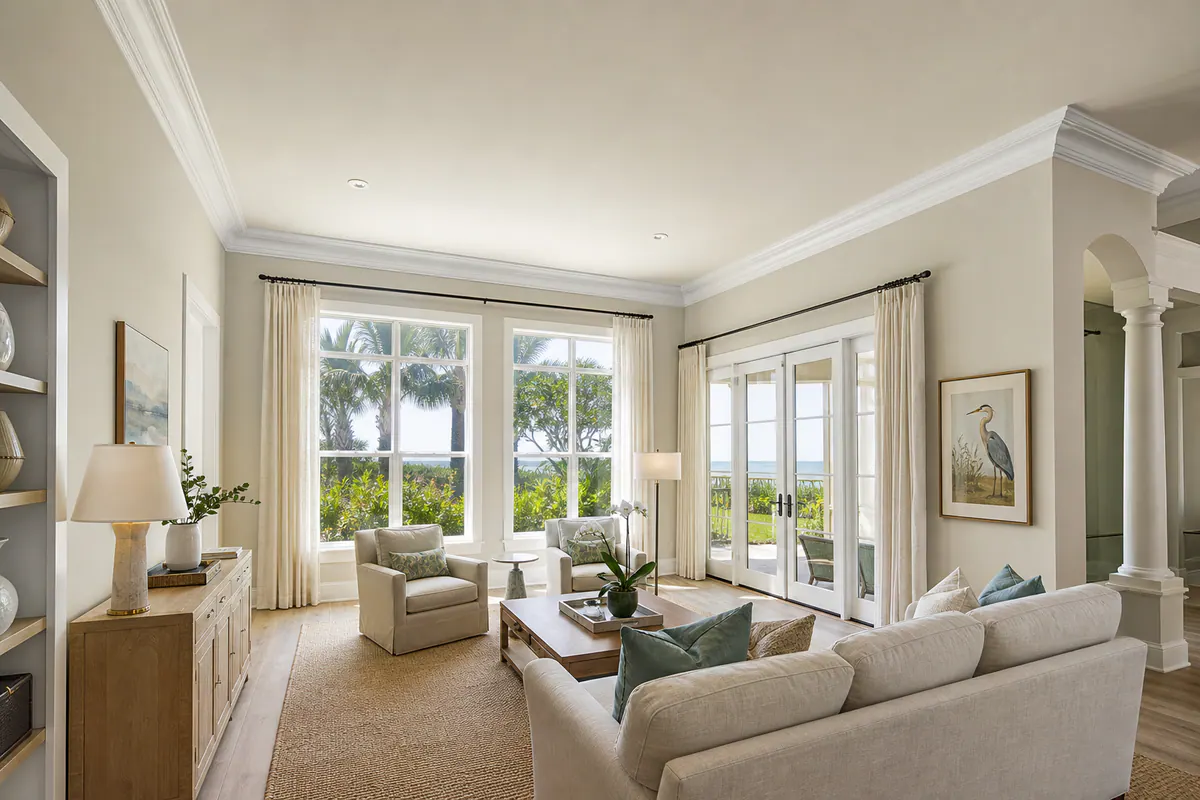
Crown molding turns the wall-to-ceiling line into a deliberate architectural detail rather than an unfinished edge. For Sarasota homeowners, it is a focused upgrade that can give a living room, dining room, bedroom, entryway, or remodel space a more finished, composed look without changing the room's layout.
Professional crown molding installation in Sarasota, FL begins with choosing a profile that belongs in the room. A streamlined, low-ornament profile supports clean contemporary interiors, while a shaped traditional profile adds depth and formality around taller or more detailed spaces. Scale matters: molding that is too heavy can crowd a modest ceiling, while a narrow profile may get lost beside substantial doors, baseboards, or window casings.
The finish is especially visible at this height. Strong work shows balanced runs, crisp inside and outside corners, transitions that line up with adjacent trim, and seams prepared to disappear beneath paint. Poor fit tends to show up as open corner gaps, uneven reveal lines, or molding that appears to wander along the ceiling. Careful layout, precise cuts, secure fastening, and finish preparation give crown molding Sarasota homeowners can appreciate from every angle.
What Crown Molding Adds to a Room
A room often feels more settled when its upper and lower trim speak the same visual language. Crown molding can soften a stark wall-to-ceiling transition, giving the eye a purposeful line to follow around the perimeter instead of an abrupt meeting of flat surfaces. In rooms with tall walls, the added horizontal detail can help the height feel balanced rather than empty.
It also helps establish a backdrop for what sits below it. Over a dining table and chandelier, around a living room's seating wall, or above a bedroom's drapery and headboard, crown gives the architecture a finished frame without competing for attention. Matching its overall visual weight to door casing and baseboards is important: substantial casing paired with very slight crown can look disconnected, while coordinated trim creates a more intentional whole. That relationship is one reason interior trim Sarasota FL projects benefit from looking at the room as a system rather than choosing one piece in isolation.
Crown is specialized upper-wall trim, not a substitute for baseboard, which finishes the floor line, or casing, which outlines doors and windows. Each has a distinct job. Crown's angled profile bridges the wall and ceiling, so its shape and scale influence room proportions more directly than flat stock used elsewhere. The best result feels integrated: lighting, furnishings, ceiling details, and adjacent trim all have space to look considered rather than crowded.
Crown Molding Styles for Modern, Coastal, and Traditional Interiors
Profile choice sets the room's tone before paint color or furniture enters the picture. Streamlined modern crown molding uses a simpler silhouette, often a clean cove, a restrained angle, or a shallow stepped face, with little ornamental relief. It complements contemporary kitchens, minimal living rooms, and bedrooms with flat-panel doors or uncomplicated window trim. In a room already defined by sleek lighting and crisp cabinetry, a heavily carved profile can feel visually busy rather than intentional.
Traditional crown profiles add more contour through curves, beads, ogees, or deeper shadow lines. They can bring welcome definition to a formal dining room, a classic living area, or a coastal-influenced interior that has substantial casing, paneled details, or furniture with more presence. The tradeoff is visual weight: intricate molding needs enough surrounding space and compatible trim to read as a design choice, not an isolated decorative stripe near the ceiling.
For a more architectural look, built-up assemblies combine two or more pieces, such as crown with a flat frieze board, base cap, or smaller accent molding, to create a wider, layered transition. This approach can suit a larger room or a remodel where the goal is to echo existing cabinetry and substantial door casings. It is usually less convincing in a compact room with plain, narrow trim, where its added depth may dominate the perimeter.
Ceiling height is a useful starting point, not a fixed sizing rule. On common 8-foot ceilings, a restrained profile often preserves breathing room; on 9-foot ceilings, a somewhat broader crown or modest built-up treatment may have enough wall area to feel balanced. Room width, window and door casing, baseboard scale, ceiling beams, and cabinet uppers all affect the right proportion. A strong selection makes the crown feel related to those elements; a weak one either disappears beside substantial trim or crowds a lower ceiling.
For crown molding Sarasota projects, comparing actual samples against the room's existing millwork is more revealing than choosing from a catalog alone. Seeing the profile at ceiling height helps homeowners judge whether clean-lined modern crown molding or layered traditional detail gives the space the intended finish.
MDF, Wood, and Paint or Stain: Choosing the Right Crown Material
Material choice affects not only the look of the profile, but also how the finished crown will be colored and blended into the room. MDF crown molding is commonly selected for painted interiors because its smooth, uniform surface can produce a clean painted appearance without wood grain showing through. It is a practical fit when the crown will match white ceilings, painted door casing, or a newly finished wall color.
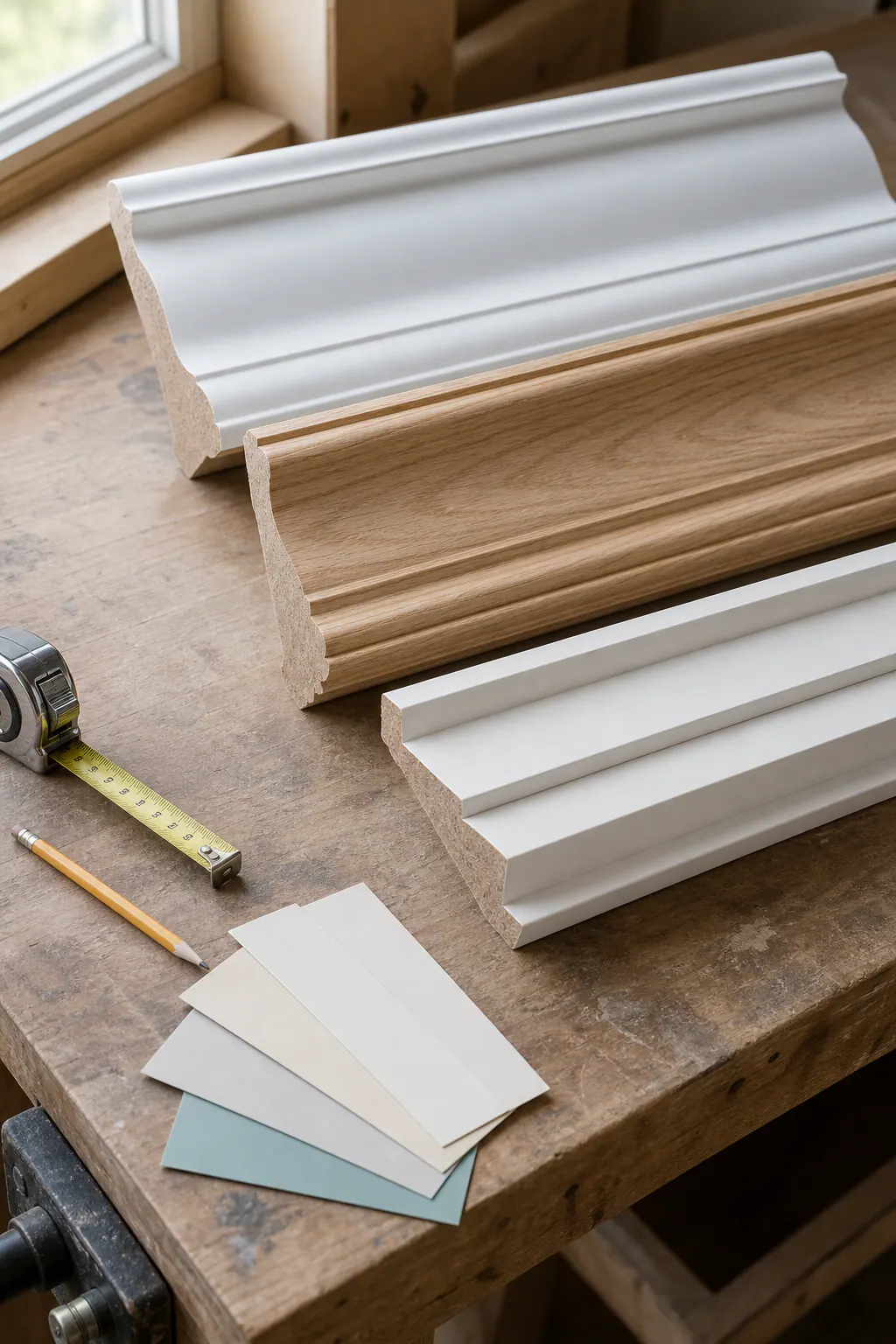
Wood crown molding brings natural grain and variation that can be part of the design rather than something to cover. It is the stronger starting point for a stained or clear-coated installation, especially when crown needs to relate to wood doors, cabinetry, beams, or existing trim. Wood also offers choices in species and grain character, but those variations mean matching boards and planning the stain color matters more. A stain that looks even on one piece can read differently on another, so material selection and finish samples should be decided together.
Paint-grade trim is intended to receive an opaque painted finish, which allows filled nail holes, prepared joints, and caulked wall or ceiling transitions to visually disappear. Stain-grade trim is chosen for an exposed wood finish; its grain, color, joint placement, and fastener treatment remain much more visible. That makes a stained crown installation less forgiving of mismatched material or poorly placed seams.
Sarasota projects also benefit from treating humidity exposure as a site-specific consideration rather than assuming one material suits every condition. The room location, ceiling condition, climate control, and proposed product all inform the choice. Whatever material is selected, the finished standard should be clear: straight runs, tidy corner transitions, filled fastener holes, and consistent caulk lines where paint calls for them. A coordinated finish plan should tie the crown to the room's ceiling, casing, cabinetry, and other visible millwork, not leave it looking like an added strip of trim.
Where Crown Molding Makes the Most Impact
Start with the rooms where the eye naturally travels upward. In a living room or foyer, perimeter crown can give a broad ceiling plane a more composed edge; in a dining room, it can strengthen the sense of occasion around lighting and furniture. Primary bedrooms and home offices often benefit from a quieter, simpler profile that finishes the room without competing with window treatments, built-ins, or a feature wall. A good fit feels proportionate to the ceiling and existing casing; a weak fit can look either lost above tall walls or overly heavy in a compact room.
Not every upper-trim detail is standard perimeter crown. Cabinet crown finishes the top of wall cabinets or a built-in, helping it meet the ceiling or read as a more furniture-like installation. A coffered ceiling uses applied beams or recessed panels across the ceiling itself, creating a grid or framed pattern; its trim is part of a larger ceiling design rather than a single line around the room. These details can complement crown molding installation in Sarasota, but they serve different visual purposes and do not need to be added together.
During a renovation, crown can be a focused upgrade rather than a reason to replace every piece of trim. Retained baseboards, door casings, cabinets, or window trim can stay in place when the new profile is scaled to relate to them and the paint or stain plan makes the transition feel intentional. The goal is continuity: aligned visual weight, clean returns at cabinets or soffits, and a finish that makes new work belong with the millwork already in the room.
What Professional Crown Molding Installation Involves
The best time to resolve fit questions is before the first length of molding is cut. A finish carpenter begins by examining the ceiling line, wall straightness, corners, soffits, cabinets, and nearby casing or built-ins that the new crown must meet. That review establishes the intended visual line and reveals whether the selected profile can make clean transitions around obstacles rather than ending in a conspicuous patch.
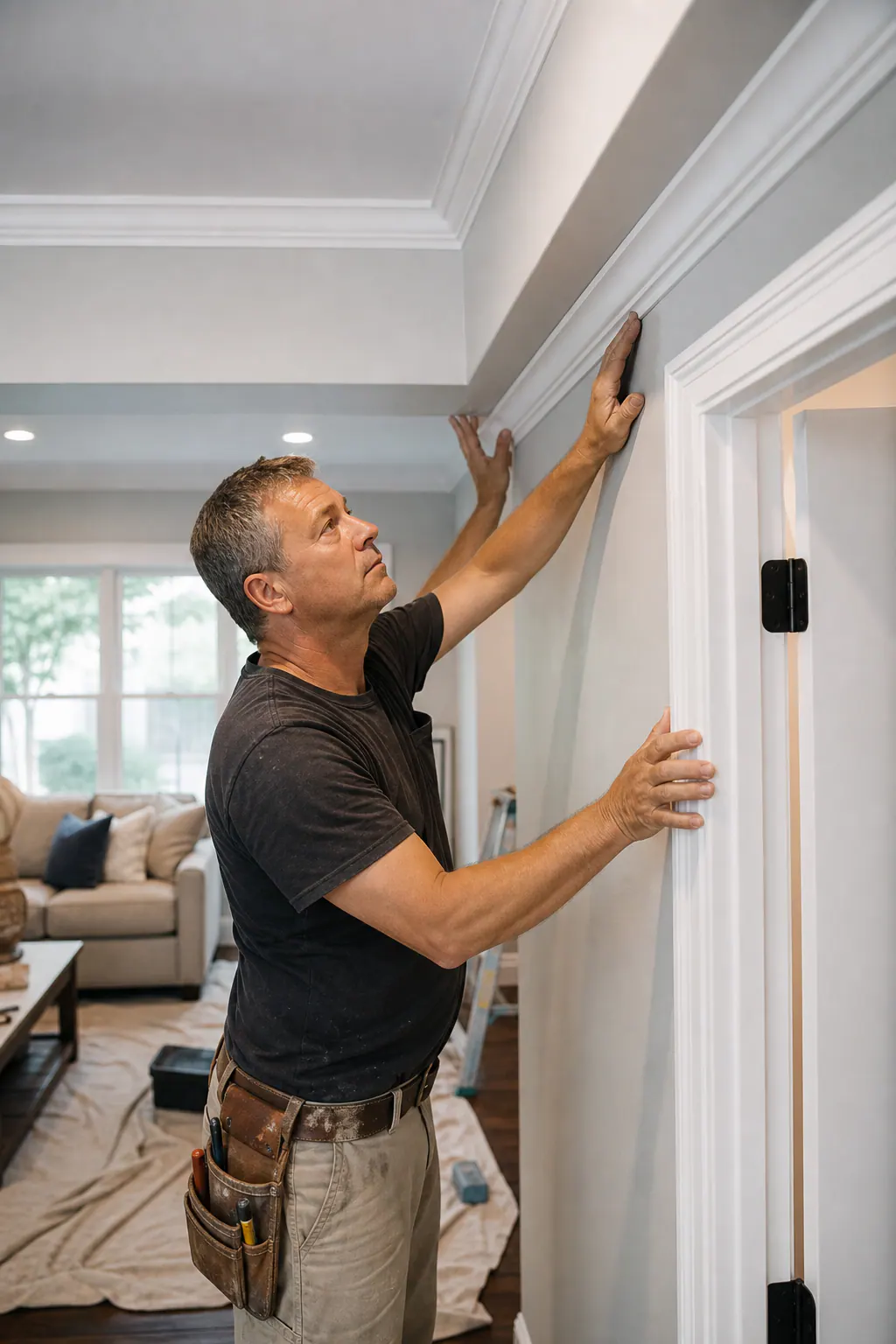
Next, the chosen profile is paired with field measurement and a material plan. Measuring every wall in place, not assuming the room is a perfect rectangle, accounts for corners that are slightly open or closed, long runs that need a planned seam, and ceilings that drift across the room. The layout can place returns and seams where they are least distracting while reserving the most visually prominent walls for the cleanest continuous runs.
Corner work is where professional crown molding installation in Sarasota is especially visible. Coping joints shape the end of one piece to follow the profile of the adjoining piece at an inside corner, helping the molding read as one continuous detail when the corner is not exactly square. Outside corners use miter joints: two angled cuts meet on a projecting edge, so their faces and profile lines must align before fastening. Before paint touch-up, a strong signal is a corner with contours that meet evenly; a weak signal is a joint with widening gaps, offset faces, or a profile that appears to jump at the corner.
Installation follows the layout with reference lines, deliberate fastening, and adjustments for uneven walls or ceilings. Rather than forcing every run to follow a wavering surface, a finish carpenter Sarasota homeowners hire can decide where a consistent reveal matters most and how crown should terminate at cabinetry, soffits, or retained trim. These small choices help the room look orderly from normal viewing distance.
For paint-grade work, finish preparation includes filling nail holes, treating seams, and readying wall and ceiling transitions for caulk and paint. When blending with existing millwork is feasible, the profile, height, returns, and finish plan are considered as one detail. That coordinated process avoids the visibly inconsistent joints and distracting transitions often left by rushed trim work.
Plan Your Sarasota Crown Molding Upgrade
A useful first conversation starts with the room itself: its ceiling height, a few overall dimensions, the existing door and window trim, and the look you want to carry forward. Photos that show each wall, corners, cabinetry, soffits, and nearby millwork make it easier to discuss whether a simple painted profile or a more layered, stain-grade treatment will feel at home in the space.
Project estimates and scheduling are shaped by the actual scope rather than a single per-room formula. A straightforward rectangular bedroom with a simple profile is a different undertaking from a living room with multiple outside corners, long runs, built-ins, uneven ceiling lines, or a built-up assembly. Material selection, profile complexity, corner count, surface preparation, and whether finishing is included all affect the work involved.
If you are planning crown molding installation in Sarasota, FL, share your inspiration photos, preferred paint or stain direction, and remodel timeline, or arrange an on-site evaluation. A room-specific review can turn those details into a tailored profile recommendation and project estimate without forcing the design decision before you are ready.
Plan the next step
Compare the broader Crown Molding Installation service.
Review the Sarasota, FL service area for local planning context.
When you are ready, request a free estimate with the rooms, trim goals, city, and available photos.
FAQs
What does crown molding add to a room?
Crown molding creates a finished transition between walls and ceilings, replacing an abrupt edge with an intentional architectural detail. It can balance tall walls and visually connect the room’s upper trim with door casing, baseboards, lighting, and furnishings.
Does crown molding work with modern interior design?
Yes. Modern interiors typically use streamlined crown profiles such as a clean cove, restrained angle, or shallow stepped face with minimal ornament. These simpler profiles complement flat-panel doors, crisp cabinetry, and contemporary lighting without making the room look busy.
What size crown molding should I choose for an 8-foot or 9-foot ceiling?
An 8-foot ceiling usually looks best with a restrained profile that preserves visual breathing room. A 9-foot ceiling can support a broader crown or modest built-up treatment, but door casing, baseboards, room width, beams, and cabinet height should also guide the final scale.
Is MDF or wood better for crown molding in Florida?
MDF is a strong choice for painted crown because its smooth, uniform surface hides grain and produces a clean painted finish. Wood is better for stained or clear-coated crown because its natural grain remains visible, especially when matching wood doors, cabinetry, or beams; Sarasota humidity, room conditions, and climate control should also be considered.
Can crown molding be added during a remodel without replacing all the trim?
Yes. Existing baseboards, door casings, cabinets, and window trim can remain if the new crown is scaled to relate to their visual weight and finished with a coordinated paint or stain plan. Clean returns at cabinets and soffits, aligned transitions, and a compatible profile help the new molding look intentional rather than added on.