
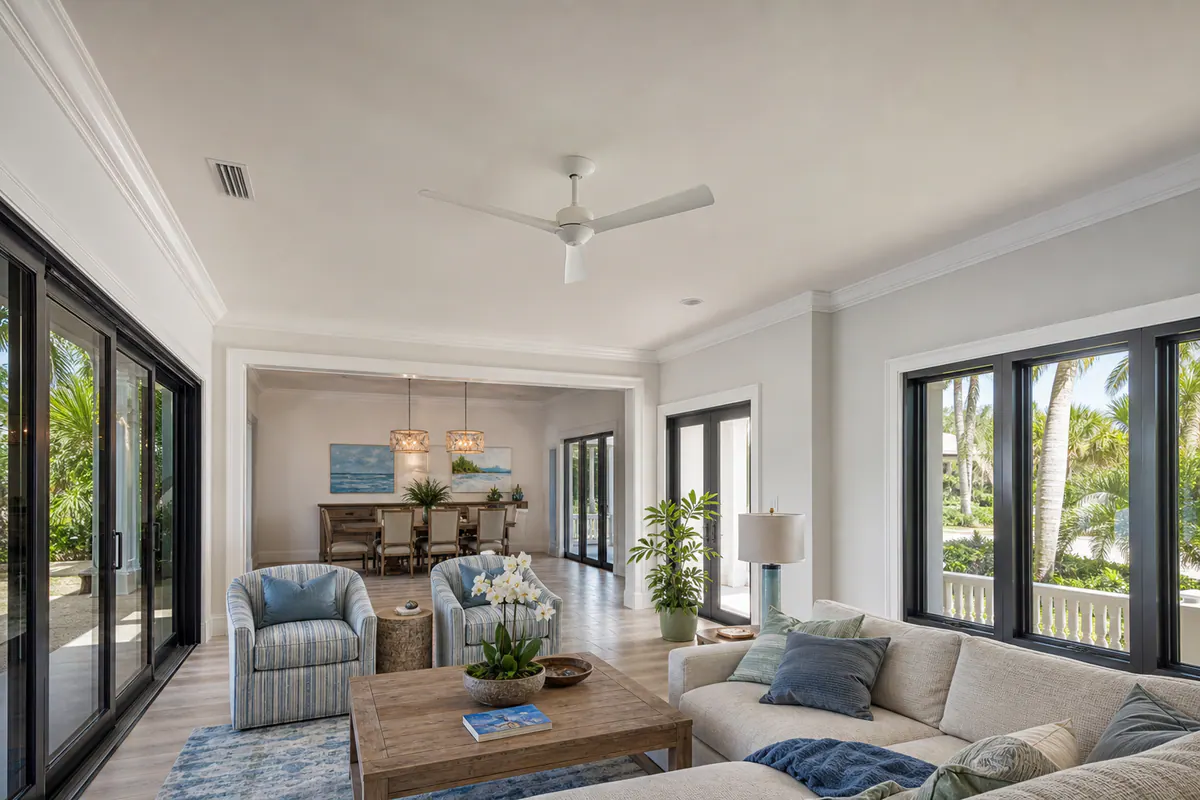
Professional Crown Molding Installation in Venice, FL
At the ceiling line, a profile that stays straight through a long living-room run and closes cleanly at each corner is the first sign that the finish was planned rather than simply added. Crown molding can give refreshed rooms more definition, carry a consistent detail through an open-plan layout, or connect new cabinetry with nearby doors, baseboards, and window trim.
The result depends on more than attaching decorative stock around the room. Professional finish carpentry begins with measuring the actual walls and ceiling lines, then choosing a profile whose projection and height suit the space. A ceiling that waves slightly, corners that are not square, and walls that drift out of plane all affect how the molding must be laid out and cut.
Corner treatment is a clear quality checkpoint. Inside corners need careful fitting so the joint reads as a continuous profile rather than a dark gap; outside corners need crisp alignment because they catch the eye first. Installers also plan fastening locations and place unavoidable seams where they are less conspicuous, rather than letting short offcuts dictate the layout.
After the molding is secured, small finish details matter: filled fastener holes, controlled caulk lines at the wall and ceiling, and touch-ups that leave a smooth, paint-ready transition. That preparation gives the painter a clean surface to finish and helps the new crown look like it belongs with the rest of the room, not like an add-on.
Choosing a Crown Profile That Fits Your Ceiling Height and Room
A profile that looks balanced in a photo can feel entirely different once it is placed against your own ceiling, windows, and door openings. A crown profile is the molded shape seen in cross-section; its height and projection create its visual presence. Molding scale is simply how substantial that shape appears relative to the room and nearby trim.
For many rooms with 8-foot ceilings, a restrained single-piece profile keeps the ceiling line defined without making the room feel top-heavy. Single-piece crown is one continuous length of molded stock, usually chosen for its clean outline and straightforward relationship to simple casings and baseboards. A deep or highly ornamented profile can crowd a lower ceiling, especially when door casings, window trim, or upper cabinets already occupy plenty of visual space.
Taller ceilings and more formal rooms can carry a broader profile because there is more wall area between the openings and ceiling. In an open living area, the goal is often consistency: crown should read as one intentional detail across connected spaces rather than changing scale abruptly at every room boundary. Viewing profile samples against the wall and ceiling, alongside a casing sample or cabinet finish, makes proportion easier to judge than selecting from a catalog image alone.
Built-up molding combines two or more pieces, such as a crown profile with a flat backer, small cove, or additional trim, to create a deeper, more layered treatment. It can give a tray ceiling or a taller living room a tailored architectural look, while a simple profile may better suit a clean-lined renovation. For custom crown molding Venice FL projects, the useful question is not "how large can it be?" but whether the assembled detail suits the room's existing visual language.
- At a tray ceiling, crown may follow the lower perimeter, the raised portion, or both; each choice changes whether the tray reads as subtle framing or a featured ceiling detail.
- Near kitchen cabinets, leave the crown design visually compatible with cabinet crown and plan how it will terminate at tall cabinets, soffits, or an adjoining wall.
- At door casings, compare the crown's weight with the casing width so the upper trim does not overpower the openings or appear unrelated.
Photos of each room, ceiling heights, and pictures of existing baseboards, casings, and cabinetry give an estimator a practical starting point for recommending crown molding Venice homeowners can picture in place.
MDF, Primed Wood, and PVC: Selecting Crown Molding Materials for Your Home
Material choice affects how the crown accepts paint, matches surrounding trim, and suits the conditions of a particular room, not just how the profile looks from the floor.

MDF crown molding is often a practical choice when the goal is a smooth, uniform painted finish. It works especially well in dry, conditioned living rooms, bedrooms, halls, and open-plan spaces where the crown is meant to blend cleanly with painted casings and baseboards. Its tradeoff is that damaged edges or areas exposed to repeated moisture deserve more caution than a simple paint touch-up can provide.
Primed finger-jointed wood uses shorter wood sections joined together and factory-primed for painting. It can be a useful direction where an existing wood molding needs to be matched, where a detail calls for a more traditional wood-based component, or where transitions and custom returns need to relate closely to nearby trim. Other wood molding may also be appropriate when a renovation is preserving a particular architectural detail rather than introducing an entirely new paint-grade system.
Moisture-resistant PVC is a paintable synthetic option to consider in locations with recurring humidity exposure, such as an area affected by persistent moisture or a transition near a bath. That does not mean every interior crown project in coastal Venice requires PVC. In a typical climate-controlled room, the desired finish, existing trim, and condition of the wall and ceiling usually matter more than choosing an exterior-oriented material by default.
- Choose a material that can carry the selected profile without making the detail look mismatched beside existing casings, cabinets, or baseboards.
- Account for wall and ceiling condition; uneven surfaces can affect the finished fit regardless of whether the molding is MDF, wood molding, or PVC.
- For interior trim Venice FL projects, share photos of adjacent trim and any moisture-prone area so the estimate can address material and finish together.
What a Clean, Paint-Ready Crown Molding Installation Looks Like
The close-up view tells the story. A paint-ready result should read as one continuous detail around the room, not a series of pieces joined by thick beads of caulk.
That starts with layout. A finish carpenter Venice FL homeowners hire for detailed trim work measures the room, identifies changes in wall or ceiling plane, and plans where full lengths, corners, and unavoidable seams will fall. In an open-plan area, a seam is generally less distracting when it is placed away from a prominent entry, sightline, or focal wall. A scarf seam overlaps two angled ends rather than butting them squarely together, creating a longer, less noticeable joint that can be secured and finished cleanly.
Corner work deserves a closer look. Outside corners need crisp, aligned miter joints so the profile continues cleanly around the projection. Inside corners may be coped, one piece is shaped to follow the face of the other, or carefully fitted as a miter, depending on the profile and conditions. The practical test is simple: the detail should meet tightly at the visible edge rather than relying on a heavy fill line to hide an open gap.
Existing walls and ceilings are not always straight, especially after prior painting, settling, drywall repairs, or renovation changes. Skilled installation accounts for those variations through measured layout, selective fitting, and fastening into appropriate backing where available. Secure fastening holds the crown in its intended position while the finish is completed; it should not leave the profile twisting, wavering, or separating from the surface.
- Look for profile lines that stay aligned through corners and across long walls.
- Expect filled fastener holes and narrow, controlled caulked gaps where minor surface variation needs blending.
- Be cautious when wide caulk lines, visibly open joints, or uneven corners are presented as normal finish work.
A crown molding contractor Venice FL homeowners consider should be comfortable showing close-up examples of corners, seams, and paint prep, not only wide room photos. Those details reveal whether the molding is ready for paint or merely attached to the wall.
Adding or Replacing Crown Molding During a Remodel or Room Update
Remodel timing can make the difference between crown that feels integrated and crown that looks added after the fact. In a kitchen update, it is often simplest to settle cabinet height, soffit changes, and any new ceiling details before finalizing the crown layout. The molding can then terminate cleanly at a cabinet run or continue through an adjoining living area with a deliberate transition rather than an improvised short return.
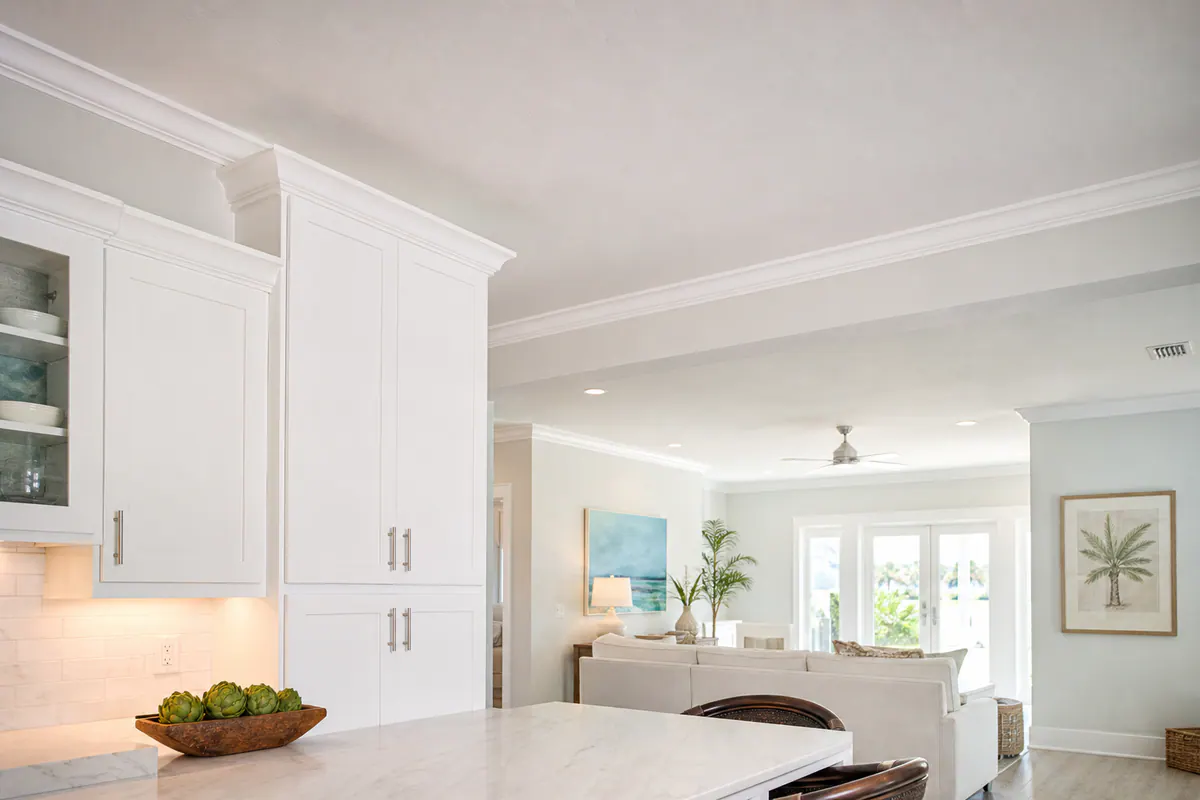
Painting projects are another natural opportunity. The usual finish sequence is to install the crown, fill fastener holes, caulk the small wall and ceiling gaps, spot-prime where the material or repairs need it, and then apply the final paint. This gives the painter one continuous trim-and-wall finish to work with. If flooring is being replaced, crown work can still be coordinated at the same time, although it does not normally need to wait on floor installation the way baseboards do.
For crown molding replacement Venice FL homeowners may not need to remove every piece of trim. A localized repair can make sense when damage is confined to a short, accessible section and the existing profile, material, and paint finish can be matched closely. Replacing an entire room is often the more cohesive choice when the old crown is repeatedly cracked, heavily built up with paint, discontinued, or inconsistent from wall to wall.
Connected rooms deserve a wider view, especially in an open-plan home. Keeping existing crown in a nearby room may be sensible when its scale and profile relate well to the update; replacing only the remodeled area can look abrupt when molding is visibly different across one uninterrupted ceiling line. During broader interior trim Venice FL work, comparing crown with door casings, baseboards, and painted cabinetry helps define a scope that looks intentional without turning a focused update into a whole-house replacement.
What Affects a Crown Molding Installation Estimate
An estimate is most useful when it describes the room conditions, not just a total number of feet around the perimeter. For crown molding installation in Venice FL, the scope begins with measured linear footage, then accounts for the profile selected, its material, ceiling height, and how easily each wall can be reached and worked around.
- Layout complexity: List inside corners, outside corners, short returns, and transitions into adjoining spaces separately. A simple rectangular room and an open-plan area with multiple ceiling breaks may have similar footage but require very different layout attention.
- Ceiling and wall conditions: Vaulted ceilings, tray ceilings, soffits, uneven surfaces, and existing texture can call for added planning so the new trim follows a deliberate line rather than highlighting irregularities.
- Removal and preparation: If existing crown is coming down, the estimate should identify removal, disposal, and any expected patching at the wall or ceiling line.
- Finish scope: Installation, hole filling, caulking, spot priming, final painting, drywall touch-ups, and related trim work are separate items worth spelling out. "Paint-ready" is not the same as including finish paint.
Photos showing each ceiling line, corners, cabinetry, and existing trim can provide a useful starting point, while an on-site review can capture access and surface details that photos miss. A clear estimate should state what is included and excluded, giving you a tailored scope rather than a one-size-fits-all package.
Request a Crown Molding Estimate for Your Venice Home
Ready to explore crown molding for your Venice home? Request an estimate for new installation, selective replacement, or trim coordination around an updated room.
To start the conversation, share the rooms involved, approximate ceiling heights, photos of the ceiling line and existing trim, and a reference image or description of the style you prefer. Include your remodel or painting timeline, too. Painting can mean prep only for the installer or a broader finish scope that includes final coats; identifying that distinction helps define the work clearly.
A site review can then match the profile to the room's proportions, plan transitions at cabinetry or adjoining spaces, and identify any surface preparation needed. The goal is straightforward: carefully fitted crown molding that is prepared for a clean painted finish and feels intentional in the finished space.
Plan the next step
Compare the broader Crown Molding Installation service.
Review the Venice, FL service area for local planning context.
When you are ready, request a free estimate with the rooms, trim goals, city, and available photos.
FAQs
What crown molding profile looks best with 8-foot ceilings?
A restrained single-piece crown profile usually fits 8-foot ceilings best. It defines the ceiling line without making the room feel top-heavy or competing with door casings, window trim, and upper cabinets.
What should I look for in a paint-ready crown molding installation?
Look for straight profile lines, tightly fitted inside and outside corners, filled fastener holes, and narrow controlled caulk lines. Wide caulk beads, open joints, wavering runs, and uneven corners are signs of poor finish work.
Does crown molding work on vaulted ceilings or tray ceilings?
Yes, crown molding can be installed on vaulted and tray ceilings, but the layout requires additional planning. On a tray ceiling, crown can follow the lower perimeter, the raised section, or both, changing whether the tray appears subtly framed or becomes a focal detail.
Is MDF or wood crown molding better for a Florida home?
MDF is a strong choice for dry, conditioned rooms because it provides a smooth, uniform painted finish. Primed finger-jointed wood is useful for matching existing wood trim, while moisture-resistant PVC is better suited to areas with recurring humidity or moisture exposure.
What affects crown molding installation cost in Venice, FL?
Cost depends on measured linear footage, profile size, material, ceiling height, access, and the number of inside corners, outside corners, returns, and transitions. Removal of existing crown, wall or ceiling repairs, caulking, priming, and final painting should also be listed separately because paint-ready installation does not automatically include finish paint.