
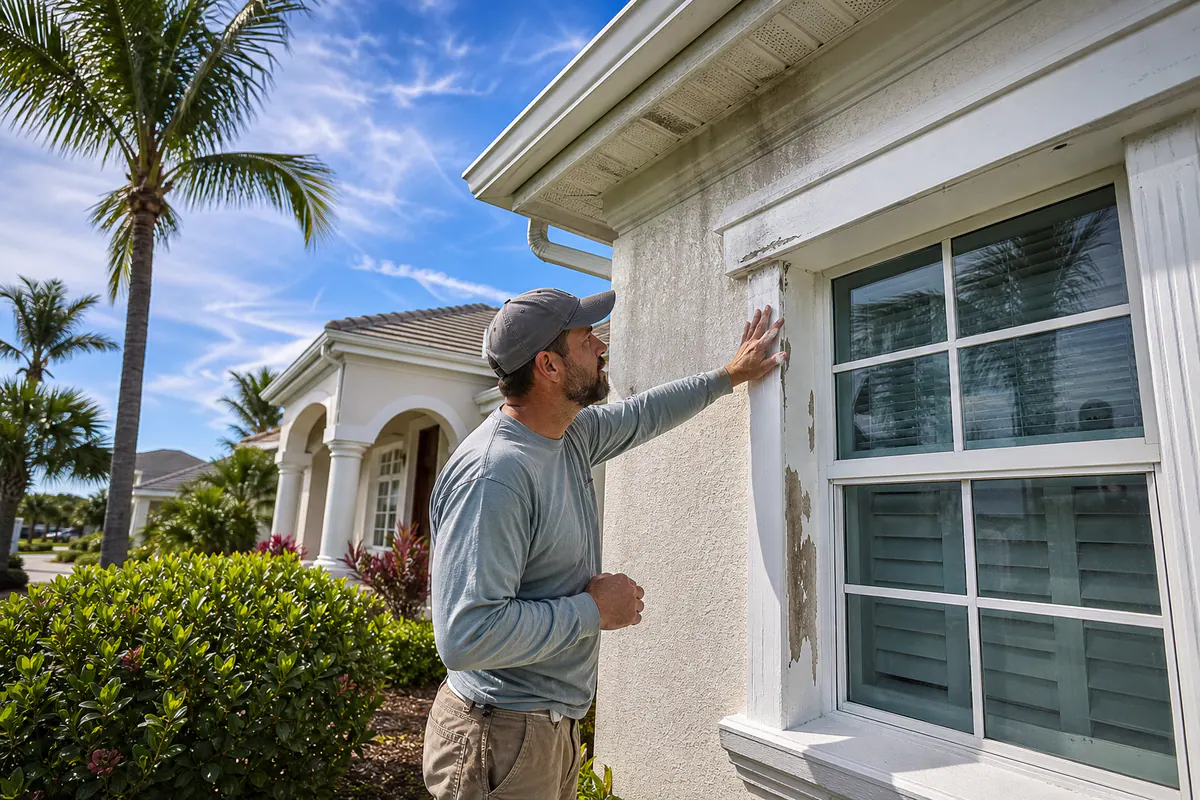
Exterior Trim Is More Than a Cosmetic Detail
For Venice homeowners, exterior trim repair is about protecting vulnerable transitions, not merely freshening up decorative boards. Trim frames windows and doors, finishes siding edges, and covers roofline details such as fascia and soffit. When its joints, coatings, and sealant lines stay intact, those areas present a more continuous exterior surface; when they open up, water can find a path behind the visible finish.
Florida exposure can make small weaknesses show up sooner. Strong sun can leave paint chalky or peeling, while humidity, repeated wet-dry cycles, wind-driven rain, and salt air near the coast can stress caulk and painted wood. Paint wear alone may be cosmetic: the board beneath it remains firm, dry-looking, and sound. A darker stain, soft spot, crumbling edge, recurring paint failure, or gap at a joint points to a different concern, material deterioration or water intrusion.
A useful repair begins by looking beyond the damaged face. Replacing a loose section and resealing its edges may be appropriate when the surrounding area is sound. If water is arriving from an opening above, beside, or behind the trim, that path needs attention too; otherwise, a clean new board can become the next visible symptom.
How to Tell Whether Exterior Trim Needs Attention
Start with a slow walk-around after a dry day, looking closely at the lower edges, corners, and joints rather than judging the paint color from the sidewalk. Sound painted trim generally feels firm and keeps a consistent profile. Soft or crumbling trim, a board that gives under gentle pressure, or an edge that breaks away when lightly probed deserves a closer look for wood rot.
- At windows and doors: Look for separated miter joints, gaps where casing meets siding, failed caulk joints, dark staining below corners, and paint that peels again soon after repainting. These signals do not automatically mean the whole assembly is damaged, but they identify areas worth opening up and assessing.
- At fascia, soffit, and rake boards: Watch for warped boards, open seams, sagging sections, discoloration at roof edges, or insect activity around softened wood. Affected trim at these locations can be a visible clue to moisture arriving from higher on the roofline.
- Along every trim run: Note nail holes that have opened, split end grain, loose boards, and gaps at joints. A small, stable paint crack differs from a joint that is widening or repeatedly reopening.
Use a blunt tool to gently test a suspicious area; the purpose is to compare it with nearby firm material, not to dig into sound trim. Then trace stains upward, outward, and alongside the board. Staining directly below a window corner may lead back to a failed joint at the casing, while deterioration at the bottom of a fascia board may point toward a roof-edge or gutter-area detail above.
Take photos of each area before painting or caulking over it. That record helps distinguish surface weathering from an active pattern of movement, trapped moisture, or recurring deterioration.
When Localized Trim Repair Makes Sense, and When Replacement Is Safer
A repair is most convincing when the problem has clear boundaries. For example, a shallow area of damaged wood on an otherwise firm, straight casing may be a candidate for localized removal and patching if the joint, coating failure, or water path that caused it has already been addressed. The repaired area should blend into solid material rather than bridge across soft wood or a moving seam.
Replacement becomes the safer choice when deterioration is no longer isolated. A board with softness in several places, rot around fasteners or end joints, a bowed or split profile, or paint and caulk that repeatedly fail is unlikely to provide a dependable base for another surface repair. The same applies when damage reaches the bottom of window or door casing, where moisture can remain concealed behind the visible face.
- Localized repair: Best suited to a small, shallow defect surrounded by firm trim, with a corrected moisture source and stable adjacent joints.
- Full-board replacement: Makes more sense when one continuous trim piece has multiple weak spots, distortion, open joints, or deterioration at attachment points.
- Broader investigation: Needed when removal reveals darkened backing, soft framing, a visible water route, or decay extending beyond the trim itself.
For rotted trim replacement in Venice, removal is often part of the diagnosis, not merely demolition. Taking off the affected section allows the installer to inspect the surface behind it and determine whether the replacement can be installed over sound backing. If that concealed area is dry, firm, and intact, the scope may stay limited. If it is not, covering it with new trim only hides the condition that caused the failure.
The practical goal is not to save every board or replace every board automatically. It is to retain sound material where it can perform and remove material that can no longer hold a stable, sealed finish.
Wood, Cellular PVC, and Composite Trim: Choosing the Right Material
The replacement board should suit the location as well as the profile already on the house. Painted wood, cellular PVC, and composite trim can each fit a Venice home, but they do not behave or finish in exactly the same way.
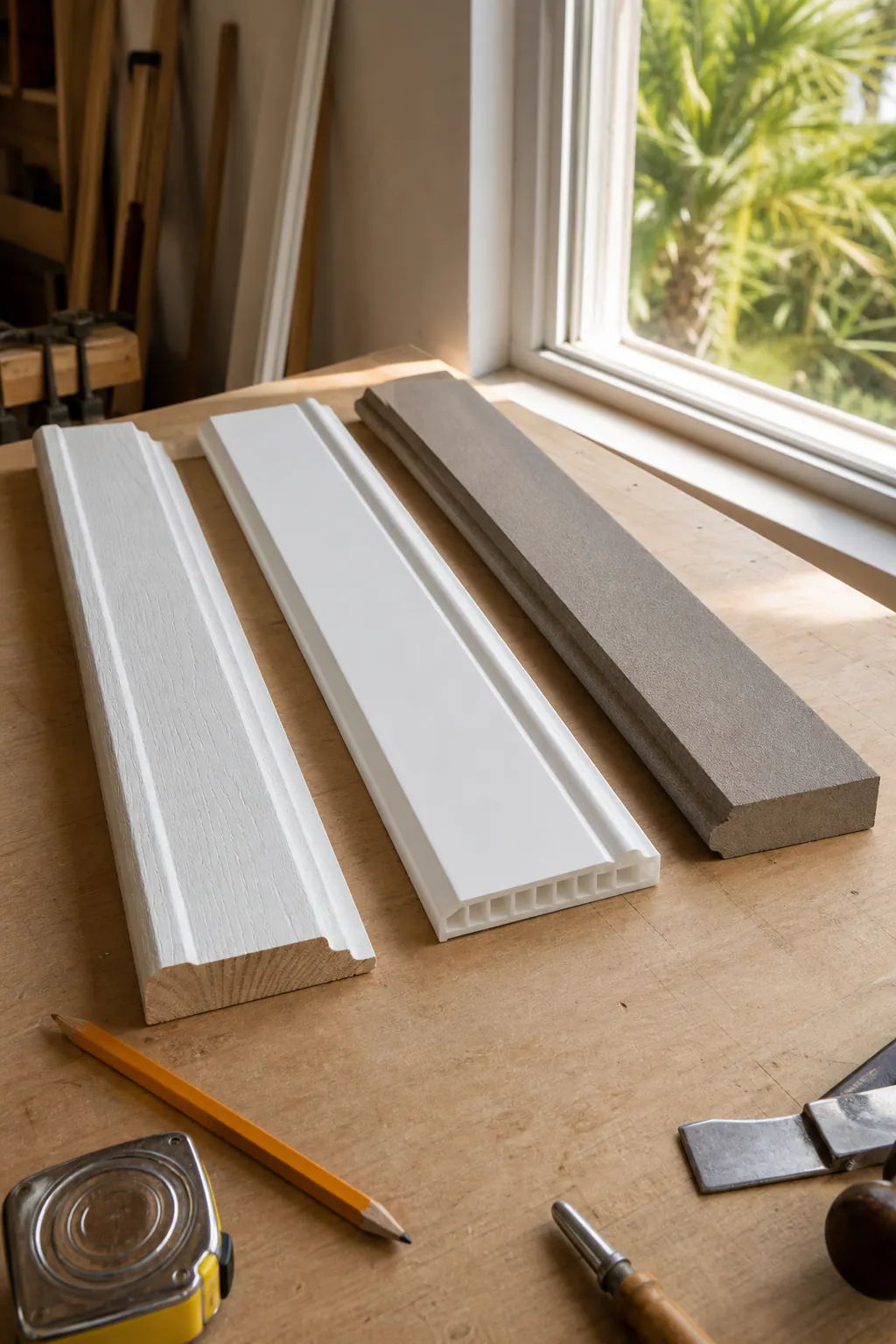
- Painted wood is traditional milled trim with crisp edges and a familiar painted appearance. It can be the better visual match for detailed casing, historic-style profiles, or areas where the existing architecture depends on wood-like depth and shaping. Its tradeoff is ongoing protection: cut ends, joints, and paint failures need prompt attention so repeated moisture exposure does not reach the board.
- Cellular PVC is a solid, paintable plastic trim material often selected where boards repeatedly get wet, such as vulnerable lower casing areas or exposed exterior corners. It does not absorb water as wood does and can be worked into many straightforward trim shapes. Paintable PVC trim still moves as temperatures change, however, so joint layout, fastening, and allowances for expansion and contraction matter to the finished appearance.
- Composite trim is a broad category rather than one single material. Products may combine wood fiber, polymers, or other engineered ingredients, and their suitable uses, cut-edge treatment, fastening methods, and paint requirements can differ substantially. A composite board may provide the look or texture a project calls for, but its performance depends on the specific product and location.
For PVC exterior trim in Venice, FL, the strongest case is usually a persistently damp or highly exposed detail, not simply every board on the home. Wood may remain the more natural choice where matching an existing decorative profile is the priority, provided the surrounding water path and finish can be maintained. Comparing actual samples beside the existing trim helps reveal differences in edge sharpness, texture, sheen, and paint finish before a material is chosen.
Fascia and Soffit Damage May Point to a Roof, Gutter, or Ventilation Issue
Roof-edge trim often tells a story about where water is traveling. Fascia boards run along the lower roof edge behind the gutter; soffit panels close the underside of the eave, while rake boards finish the sloped edges of a gable. Staining below a gutter, peeling confined to the roofline, soft spots near fasteners, or sagging soffit can point to a concentrated issue rather than ordinary surface aging.
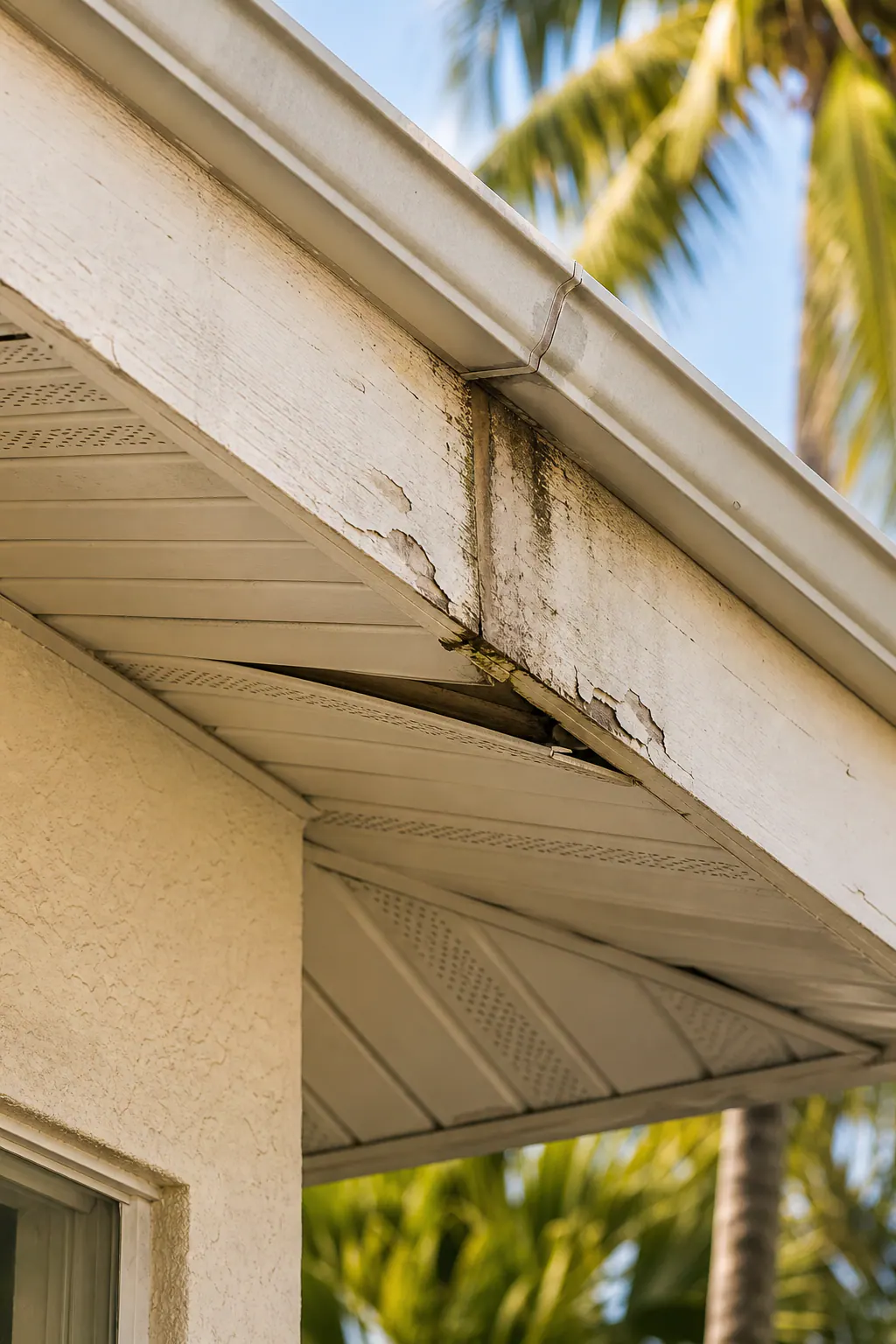
During fascia repair in Venice, FL, it helps to look at the adjacent water-management details before deciding that the board alone is the problem. A gutter that overflows, leaks at a seam, pulls away from the fascia, or stays clogged can repeatedly wet the same edge. Drip edge, the metal flashing intended to guide roof runoff away from the roof decking and into the gutter, also deserves attention. If it is absent, damaged, or directing water behind the gutter, a new fascia board may be exposed to the same water path.
- Damage localized below a leaking gutter joint or overflowing section suggests drainage should be corrected along with the trim work.
- Decay that extends behind fascia or appears at a rake board may justify a closer look for roof leaks or water entering higher on the roof edge.
- Discolored, loose, or damp-looking soffit panels can warrant an inspection of nearby roof-edge openings and attic ventilation paths. Ventilation does not stop a roof leak, but blocked or inadequate airflow can leave moisture conditions unresolved.
Replacing only the visible fascia can improve appearance temporarily, but it cannot redirect runoff, repair a roof opening, or restore airflow. The lasting approach is to replace material that has lost its integrity while addressing the gutter, drip-edge, roof, drainage, or ventilation condition that allowed the deterioration to develop.
Window and Door Trim Repairs Need Proper Sealing and Finishing
Openings around windows and doors deserve a close look because several exterior layers meet in a small area. Window casing and exterior door trim should sit firmly, with closed, orderly joints and a finish that remains bonded. A narrow paint crack may be surface wear; a split at a miter, a gap where trim meets siding, soft material, or peeling that repeatedly returns points to a detail that needs more than touch-up paint.
A durable repair starts by removing loose caulk, failed paint, and deteriorated trim rather than coating over them. Once the remaining surfaces are clean, dry, and sound, the replacement or repaired area can be fitted so its transitions remain intentional. Sealant belongs at joints designed to be sealed, while flashing and other water-shedding details need to remain able to direct water outward. Filling every visible opening can trap water behind the trim instead of allowing the assembly to drain.
- At trim-to-siding joints, an intact, flexible-looking sealant line is a better sign than a brittle, separated bead or a joint packed with repeated layers of caulk.
- At a window or door perimeter, staining above the casing, open seams at corners, or deterioration behind a removed board calls for a closer look at the transition, not just a new bead of sealant.
- For exterior door trim replacement in Venice, FL, the new material, primer, paint, and sealant should be selected as a compatible finish system for the installed trim, whether it is wood, cellular PVC, or composite.
Primer and paint protect prepared trim surfaces and give the repair a consistent appearance, but they do not restore a failed joint or damaged flashing. Good finishing follows the repair: sound material is secured, water-shedding paths are preserved, appropriate joints are sealed, and exposed faces and edges receive complete coating coverage.
A Practical Process for Exterior Trim Repair and Replacement in Venice
A clear scope begins at the damaged area but does not stop there. An on-site review should note the affected casing, fascia, soffit, or door trim; test the surrounding material for firmness; and trace nearby clues such as open joints, gutter overflow marks, staining, or repeated paint failure.
- Identify whether the damage is isolated and whether a visible water path, failed transition, or roof-edge issue may be feeding it.
- Set the repair scope: retain firm material for a localized repair, or remove boards that are soft, distorted, extensively deteriorated, or unable to hold a stable finish.
- Match the replacement material and profile to the location. Wood can preserve an existing look, while cellular PVC or composite may suit selected exposed details when installed and finished as part of a compatible system.
- Remove damaged material, install the new trim, address related corrective work within the agreed scope, then seal appropriate joints and finish exposed surfaces.
- Walk through the completed details and identify maintenance priorities, including areas to watch for fresh separation, staining, or coating breakdown.
If trim feels soft, damage returns after prior painting, or staining appears around windows, doors, gutters, or roof edges, arrange an on-site assessment for exterior trim replacement in Venice, FL. The right scope should follow what the inspection finds, not just what is most visible from the ground.
Plan the next step
Compare the broader Exterior Trim Repair and Replacement service.
Review the Venice, FL service area for local planning context.
When you are ready, request a free estimate with the rooms, trim goals, city, and available photos.
FAQs
Can rotted exterior trim be repaired, or does it need to be replaced?
Localized repair can work for a small, shallow defect surrounded by firm, dry trim after the moisture source and failed joint have been corrected. Full-board replacement is safer when a board has multiple soft spots, rot at fasteners or end joints, bowing, splits, or repeatedly failing paint and caulk.
How do I know if water-damaged window trim is only cosmetic?
Cosmetic paint wear leaves the board firm, dry-looking, and structurally sound. Dark staining, soft spots, crumbling edges, separated miter joints, gaps at siding, or paint that quickly peels again indicate deterioration or water intrusion that needs further inspection.
What causes fascia boards to rot in Florida?
Fascia rot often results from repeated wetting caused by overflowing or leaking gutters, clogged drainage, damaged or missing drip edge, and roof-edge leaks. Strong sun, humidity, wind-driven rain, and salt air can also accelerate paint and caulk failure around the roofline.
Should exterior trim be caulked before painting?
Remove failed caulk, loose paint, and deteriorated material first, then secure sound trim and seal only joints designed to be sealed. Primer and paint should fully coat exposed faces and edges, but caulk should not block flashing or drainage paths that need to shed water outward.
Is PVC exterior trim worth it for homes in Venice, FL?
Cellular PVC is a strong choice for persistently damp or highly exposed details, such as lower window casing and exterior corners, because it does not absorb water like wood. It still expands and contracts with temperature changes, so proper joint layout, fastening, and expansion allowances are required; wood may be better for matching detailed traditional profiles.