

For homeowners considering trim installation in Englewood, FL, the right details do more than decorate a room. Interior finish trim creates intentional transitions where floors meet walls, doors and windows meet drywall, and walls meet ceilings. Baseboards cover the floor-to-wall edge, casing gives openings a clean frame, and crown molding can soften the wall-to-ceiling transition. Well-fitted pieces keep reveals even, joints tight, and surfaces ready for a smooth painted finish.
Exterior trim has a different job. Fascia, soffit trim, and window or door surrounds finish exposed edges while helping create a continuous, orderly exterior. In an Englewood home, those pieces must suit their location: humid air, strong sun, wind-driven rain, and coastal air place different demands on a shaded interior wall than on a roofline or opening exposed to weather.
That is why material selection should follow the application. Painted wood can provide a traditional profile and crisp custom detail indoors, while MDF is generally best reserved for dry interior areas. PVC and fiber-cement options are often considered for exterior locations where moisture exposure and movement matter. No single material is automatically right everywhere; a thoughtful installation accounts for the profile, substrate, exposure, fastening, joints, sealant, and finish as one system.
The visible standard is straightforward: straight runs, consistent spacing, clean corners, sensible transitions between materials, sealed exterior edges, and trim that looks integrated with the home rather than added as an afterthought.
Residential Trim Services: Interior Details and Exterior Finishing
A room-by-room view makes the scope of residential trim work easier to plan. Along floors, baseboards create a deliberate lower edge; shoe molding and quarter round are smaller profiles that can cover a narrow gap between the baseboard and flooring. Shoe molding is typically slimmer and more flexible-looking, while quarter round has a more pronounced curved face. Either can be useful where an existing floor is not perfectly straight, but neither should substitute for a baseboard that is poorly fitted to the wall.
Around openings, door casing covers the joint between the jamb and wall, and window casing gives the opening a finished frame. Crown molding is installed at the ceiling line to add a stronger architectural transition, while decorative wall trim, such as panel molding, board-and-batten layouts, or picture rails, organizes a broad wall into intentional sections. Good finish carpentry in Englewood, FL considers how these profiles relate: matching thicknesses, aligned reveals, and corners that meet cleanly make separate details feel like part of one room.
Outside, the work shifts from appearance-led finishing to exposed-edge protection. Fascia covers the board at the roof edge, soffit trim finishes the underside of an overhang, and rake boards follow the sloped edge of a gable. Exterior window and door surrounds finish vulnerable perimeter joints, while deteriorated boards may need targeted replacement before new trim is installed. These pieces must be cut, fastened, joined, sealed, and finished for their particular exposure rather than treated like indoor millwork.
For Englewood trim work, that distinction matters most at rooflines and openings that see sun, wind-driven rain, humidity, and coastal air. Indoors, the priority is usually a stable fit and paint-ready surface in a conditioned space. Outdoors, joints and transitions need room for ordinary material movement and careful sealing so water is directed away from the trim and the surface behind it.
Interior Finish Carpentry: Baseboards, Casing, Crown Molding, and Wall Details
Proportion is the decision that keeps these details from feeling either undersized or overly formal. A taller, more substantial baseboard can give an open living area a stronger visual foundation, while a simpler, lower profile often suits smaller rooms or contemporary interiors. Existing flooring matters, too: a finished floor with an uneven perimeter may benefit from shoe molding, whereas a clean new-floor installation may look better with the baseboard meeting the floor directly. Thoughtful baseboard installation in Englewood, FL considers adjoining door casings so the profiles and thicknesses look intentional together.
Casing draws attention to doors and windows, so its width and profile should fit the room's character. A flat, square-edged casing reads clean and modern; a stepped or more detailed profile supports traditional styling. Crown molding has a different visual role, pulling the wall and ceiling together. It can work in a lower-ceiling room when the projection and profile remain modest rather than creating a heavy band overhead. In rooms with more height, a larger crown or built-up treatment can carry more presence without overwhelming the ceiling line.
Wainscoting and other decorative wall trim change a plain wall into a designed surface. Board-and-batten introduces vertical rhythm, panel molding creates framed rectangles, and a chair rail can establish a horizontal break. These treatments work best when their spacing relates to windows, doors, outlets, and furniture rather than ending in awkwardly narrow sections. Matching the trim to the wall paint creates a quieter layer of depth; a contrasting color makes the geometry a focal point.
The finish is where careful work becomes easy to see. Miters should close neatly at outside corners, profile edges should line up across joints, and casing reveals, the narrow, even border left around a jamb, should remain consistent. Secure fastening prevents loose pieces and visible movement. Small nail holes, seams, and wall-to-trim edges need filling and smooth caulking before paint, while overly thick caulk lines, open joints, mismatched returns, or wavering spacing signal work that will remain noticeable after the room is finished. This attention to detail is central to quality crown molding in Englewood, FL and other interior finish upgrades.
Exterior Trim Repair and Replacement for Gulf Coast Exposure
Rooflines and exterior openings deserve their own inspection because the trim there sits at the boundary between the finished exterior and the assemblies behind it. Exterior fascia is the board along the roof edge, while soffit trim finishes the underside of an overhang and rake boards follow a sloped gable edge. Window and door surrounds frame openings and cover transitions around their perimeter. Each location needs pieces that fit cleanly while allowing water to shed away from vulnerable edges rather than collecting at joints.

In Englewood, sun, humid air, wind-driven rain, and salt-air exposure can be hard on exposed coatings, seams, and fasteners. Peeling paint by itself may be a finish-maintenance issue, but soft spots, staining, cracked boards, open joints, loose trim, or repeated moisture marks call for a closer look at both the trim and the material behind it. A fresh coat of paint can improve appearance, but it should not be used to hide an active leak, failed flashing detail, or drainage problem.
A localized repair can make sense when deterioration is limited to a short section and the adjacent trim, backing, and surrounding surfaces remain firm and dry. The replacement piece should match the profile and thickness closely enough to create a straight transition, with secure fastening, sealed end cuts and joints, and a finish-ready surface. A patch that leaves soft neighboring material or an unaddressed open seam is likely to look temporary.
Broader replacement is often the more sensible path when damage appears across several runs, boards have lost structural integrity, or water has continued entering from the same area. The underlying moisture route should be corrected before new trim closes the area back up. For exposed edges, rot-resistant trim may be worth considering, but the material choice still needs to suit the location, movement at connections, desired profile, and planned coating system. Careful trim installation in Englewood, FL means treating a clean exterior line and reliable water management as connected parts of the same repair.
Choosing Wood, MDF, PVC, or Fiber-Cement Trim by Location
Material choice becomes clearer when each trim run is matched to the conditions it will actually face, rather than using one product throughout the house. Inside a dry, conditioned room, appearance, profile options, and a smooth painted finish may lead the decision. At an exposed roof edge or around an exterior opening, moisture tolerance and how the pieces handle seasonal movement carry more weight.
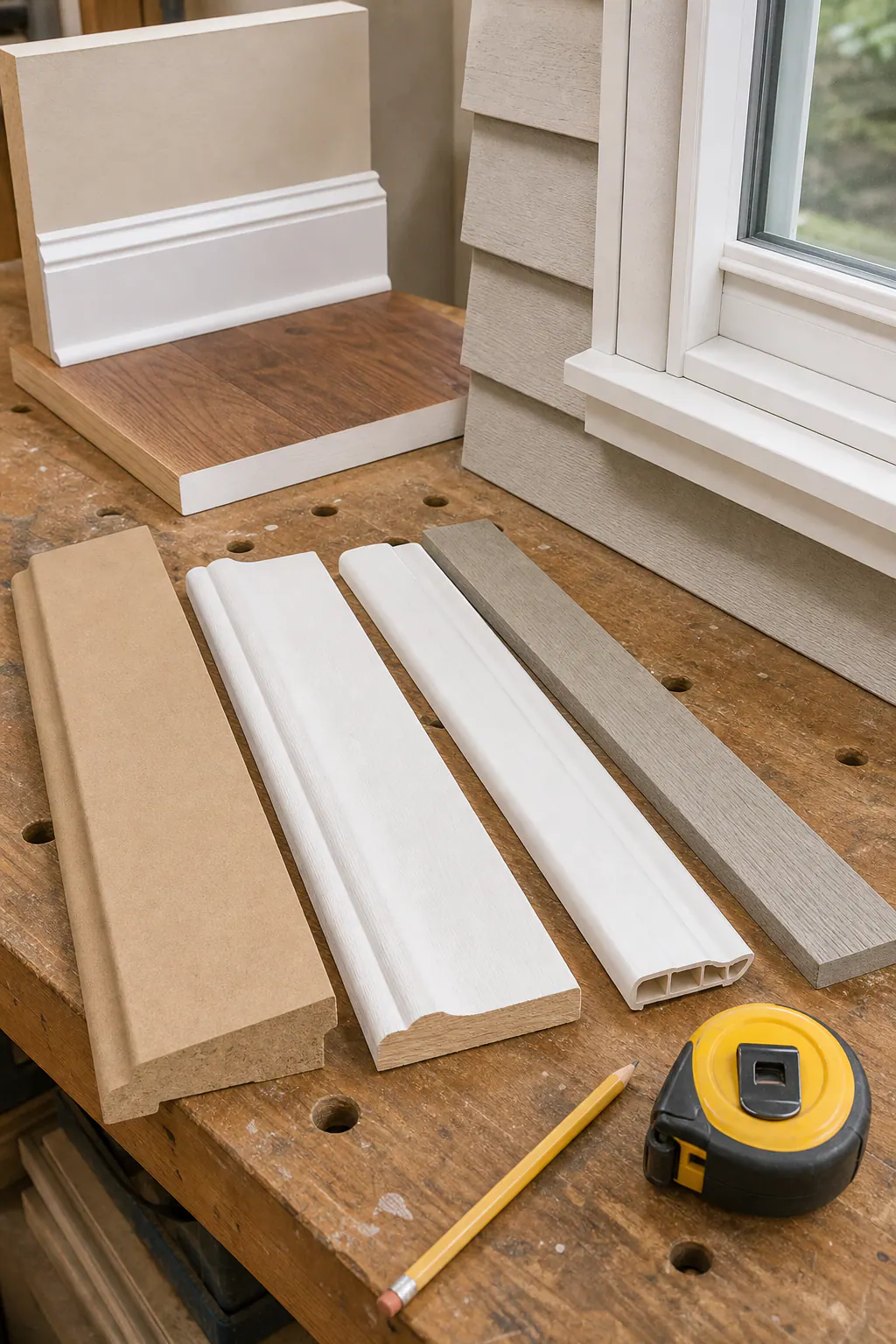
- Painted wood is a flexible choice for detailed interior casing, baseboards, crown molding, and custom profiles because it can be shaped, repaired, and painted to suit the room. It can also be used outside when the detail is properly protected, but exposed end grain, joints, and cut edges need careful sealing and ongoing paint maintenance. Wood is less appealing where repeated wetting is expected.
- MDF provides a smooth, uniform surface for painted interior trim and can work well for baseboards, casing, and decorative wall details in dry spaces. It is generally a poor choice beside repeatedly wet areas or for exterior use, where swelling at damaged paint or exposed edges can spoil an otherwise clean installation.
- PVC trim is often a practical exterior option for locations that see regular moisture, such as fascia details and window or door surrounds. It does not solve a flashing or drainage problem, and it moves as temperatures change. Proper fastening, joint treatment, expansion allowance, and a compatible paint plan help the finished run stay neat rather than opening or buckling.
- Fiber-cement trim can suit exterior applications that call for a durable, paintable board with a more traditional painted appearance. The tradeoff is installation handling: cuts, edges, fastening, and support need to be executed for that specific product so the board sits flat and the finish can perform as intended.
For trim installation in Englewood, FL, the useful checkpoint is not simply whether a board is marketed as moisture-resistant. Consider the profile, the surface behind it, direct weather exposure, nearby joints, and the intended paint system together. A moisture-tolerant board installed over a persistent water path is still part of a weak exterior detail; a well-fitted board with correctly managed transitions has a much better foundation for a lasting finish.
Before materials are ordered, match the selected product to the needed profile and the installation method it calls for. Fastener type and spacing, expansion gaps, joint layout, cutting approach, and finishing steps can differ substantially between wood, MDF, PVC, and fiber-cement products.
Planning Trim Installation Around Flooring, Painting, and Existing Conditions
Good trim starts with layout, not a saw cut. A carpenter first looks for bowed walls, uneven floors, ceiling variation, out-of-square openings, loose existing trim, and sound backing for fasteners. Those conditions determine where joints fall and whether a profile can run continuously. For example, a low spot in a floor may call for a scribed baseboard edge or discreet shoe molding; forcing a straight board down can leave an obvious gap.
Baseboards are commonly set after finished flooring so their lower edge meets the actual floor height. Door and window casing, along with decorative wall trim, can be scheduled around flooring and painting when the reveal lines and final wall finish are planned together. Crown molding requires a ceiling-and-wall check before corners are measured, since a slightly uneven ceiling can make a perfect miter look open.
For replacement work, damaged boards come off before new pieces are measured. Soft backing, failed sealant, or a moisture path needs correction first; new exterior trim should not merely cover the same underlying problem.
The practical sequence for Englewood FL trim installation is layout, careful cutting and dry fitting, secure fastening, then filling nail holes, caulking paintable interior gaps, sanding, and coordinating final paint. The finish-ready standard is consistent reveals, aligned profiles, tight corner joints, clean transitions, and caulk lines that are smooth rather than bulky.
What to Look for in an Englewood, FL Trim Carpenter
Before choosing an Englewood, FL trim carpenter, ask to see work similar to your project. Interior photos should show aligned profiles, even casing reveals, and corners that look intentional; exterior examples should show neat transitions and finished edges around exposed areas.
- Ask how material choices change between a conditioned room, a damp-prone area, and an exposed exterior location.
- Request a written scope listing the trim profile, each room or exterior run, removal and prep work, painting responsibility, and exclusions.
- Discuss what happens if removal exposes soft exterior backing, failed sealant, uneven walls, or floors that require scribing or another fitting adjustment.
A clear conversation about those conditions helps distinguish straightforward installation from repair or replacement work. Request an on-site assessment and a project-specific scope for your trim upgrade, repair, or replacement.
Plan the next step
Compare the broader Trim Installation service.
Review the Englewood, FL service area for local planning context.
When you are ready, request a free estimate with the rooms, trim goals, city, and available photos.
FAQs
What is included in professional baseboard installation?
Professional baseboard installation includes checking floors and walls for unevenness, measuring and dry fitting trim, secure fastening, and scribing or using shoe molding where needed. It also includes filling nail holes, caulking paintable gaps, sanding, and preparing the trim for a smooth painted finish.
Does crown molding work in homes with lower ceilings?
Crown molding can work in lower-ceiling rooms when the profile and projection remain modest. Larger or built-up crown treatments are better suited to rooms with more ceiling height, where they will not create a heavy band overhead.
Why are trim joints opening or exterior boards showing damage in Florida?
In Englewood, strong sun, humidity, wind-driven rain, and coastal air can stress coatings, seams, and fasteners. Open joints, soft spots, staining, cracked boards, loose trim, or repeated moisture marks can indicate water intrusion, failed sealant, flashing problems, or drainage issues that must be corrected before replacement.
Can damaged exterior trim be repaired, or does it need to be replaced?
Localized repair is appropriate when damage is limited to a short section and adjacent trim, backing, and surrounding surfaces are firm and dry. Broader replacement is needed when damage affects several runs, boards have lost structural integrity, or water continues entering from the same area.
How do I choose between wood, MDF, PVC, and fiber-cement trim in Englewood, FL?
Use painted wood for detailed interior profiles and dry-space custom work, and use MDF only in dry interior areas because it can swell when exposed to moisture. PVC is well suited to regularly wet exterior locations but needs expansion allowance and compatible fastening, while fiber-cement provides a durable paintable exterior board that requires product-specific cutting, edge treatment, fastening, and support.